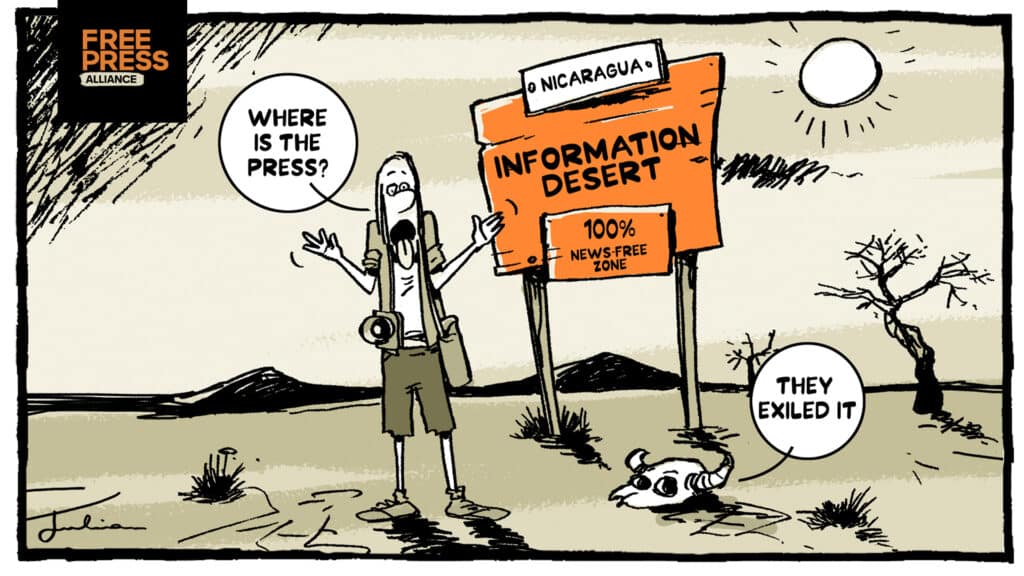
Nicaragua now has, for practical purposes, no independent press operating on its own soil. Nearly two decades into Daniel Ortega’s presidency, and eight years after the anti-government protests of April 2018, the country’s media landscape has been reduced to state and family-controlled outlets, a scattered diaspora of exiled newsrooms, and legal architecture built to keep both from ever converging again.
A Strategy Refined Over Two Decades
A report from the exiled journalist network Las Exiliadas Nicas, produced with support from Reporters Without Borders Spain and presented in Madrid in April 2026, describes the campaign in stark terms: sixty-one media outlets shut down, journalists imprisoned, more than 300 forced into exile, and roughly two-thirds of Nicaraguan territory left without any local news coverage at all, what press-freedom monitors now call a “news desert.”
The pattern is not new, but it has accelerated. According to Freedom House’s 2026 country report, the independent outlet El Confidencial calculated in March 2026 that the regime had shut down or confiscated at least 61 national media outlets since 2007, stripped 25 journalists of their citizenship, forced 283 into exile, and imprisoned 15, four of whom remained in detention.
The Legal Architecture of Repression
The crackdown has been backed at every stage by legislation. As RSF documents, the National Assembly passed a package of laws in 2020 that has since been used systematically against independent reporters: a foreign-agents law requiring anyone receiving funding from abroad to register with the government, effectively giving the state a legal pretext to shutter foreign-funded newsrooms and NGOs, and a cybercrime law criminalizing the spread of “false information,” later amended to extend its reach to Nicaraguans living abroad.
A newer telecom law adds another layer of control over online distribution, prompting exiled outlets to build mirror websites, alternative distribution channels, and VPN-literacy campaigns for their remaining audience inside the country, as LatAm Journalism Review has reported.
State Capture of the Airwaves
Where outlets haven’t been closed outright, many have been absorbed. The Ortega-Murillo family directly controls several national broadcasters, including television channels 8, 4, 9 and 13, and radio stations such as Radio Ya and Radio Sandino, turning what remains of the licensed broadcast spectrum into a propaganda apparatus rather than a source of independent news, according to RSF’s country profile.
The clearest single case is La Prensa, Nicaragua’s oldest and most prominent newspaper. Police raided its Managua offices in August 2021 after the government cut off its supply of newsprint and ink, and in 2022 the regime formally confiscated the building and its assets; Vice President Rosario Murillo announced the site would become a “cultural and polytechnic center,” as Newsroom Panama recounts. The paper survives only as a digital publication produced from exile.
Statelessness as a Weapon
Since 2018, the regime has paired closures with a second tactic: erasing journalists’ legal identity. In February 2023, a court stripped 94 Nicaraguans of their nationality, including at least eleven journalists and writers such as Sergio Ramírez and Gioconda Belli, branding them “traitors” and confiscating their property and pensions, PEN International reported at the time. Days earlier, 222 political prisoners, including journalists and media executives, had been deported to the United States and likewise denationalized on arrival.
More recently, the regime has shifted to a quieter version of the same tool. Rather than issuing public denationalization lists, authorities now decline to renew passports, IDs and birth certificates for critics in exile, producing what the UN Group of Experts has called “de facto statelessness,” as El País/Havana Times detailed in reporting on journalist Néstor Arce, who discovered his passport had been reported “stolen” by Nicaraguan immigration officials while he was travelling to accept a press-freedom award.
Repression That Follows Journalists Abroad
Exile has not put reporters out of reach. In January 2026, the Committee to Protect Journalists documented a pattern of covert persuasion, coercion and psychological pressure aimed at some of the estimated 268 Nicaraguan journalists now living abroad, many in neighboring Costa Rica. Journalists who spoke to CPJ on condition of anonymity said Nicaraguan state security agents have continued contacting them and their relatives, seeking information about the whereabouts of other exiled reporters.
2026: Consolidating Power, Widening the Net
This year has brought further institutional entrenchment. Constitutional reforms made Ortega and Murillo formal “co-presidents,” extended their terms to six years, and gave the presidency explicit authority to “coordinate” the legislature, judiciary, electoral bodies, and police, changes criticized by the United Nations, the OAS, the United States, and the European Parliament, per Freedom House.
The net has also widened beyond media. In July 2026, the regime stripped what human rights lawyer Reed Brody described to the Associated Press, via Al Jazeera, as likely hundreds, if not thousands, of lawyers of their professional certification, without any official notification. “First they closed the NGOs, the universities, the independent media,” Brody said. “They’ve gone after the churches, and now it seems the legal profession. Anyone who might stand between the government and citizens.”
A Press That Refuses to Disappear
Despite the closures, exiled Nicaraguan journalism has not gone silent. Outlets such as Confidencial, 100% Noticias, Artículo 66, Nicaragua Investiga and Radio Darío continue publishing from Costa Rica, the United States and Spain, reaching audiences inside Nicaragua primarily through social media, VPNs and mirror sites, as documented by Coda Story and LatAm Journalism Review. A group of Nicaraguan journalists rendered stateless has formally asked the Spanish government for protection, arguing they have effectively lost their nationality with no legal avenue to reclaim it.
Why It Matters
Nicaragua’s trajectory is frequently cited by press-freedom organizations as a case study in how a government can dismantle an independent media sector without a single formal declaration of censorship: selective legislation, financial strangulation, confiscation, denationalization, and, for those who escape, sustained pressure from abroad. The tools- foreign-agents registries, “false news” statutes, and passport denial- are not unique to Nicaragua, and rights groups increasingly warn that neighboring governments are watching the model closely.
Sources: