For years, Peru was regarded as one of South America’s most vibrant media environments. Investigative journalists exposed corruption scandals, uncovered abuses of power, and played a central role in holding political leaders accountable. Today, however, that environment is under growing threat.
The deterioration of press freedom in Peru has become one of the most alarming developments for journalism in Latin America. Recent investigations by the Committee to Protect Journalists (CPJ) document how journalists face increasing threats from organized crime, political hostility, and institutional weakness, creating what press freedom advocates describe as a steadily worsening environment for independent reporting.
A dramatic fall in press freedom
The decline is measurable. According to Reporters Without Borders (RSF), Peru has fallen dramatically in the World Press Freedom Index over the past several years, reflecting an increasingly hostile environment for journalists. RSF has warned of a “major offensive against press freedom” in the country, citing legislative attacks, judicial harassment, surveillance of reporters, and public campaigns aimed at discrediting independent media.
The deterioration is not the result of isolated incidents but part of a broader pattern in which state institutions have become increasingly willing to target journalists who investigate corruption and abuses of power.
This trend mirrors developments seen elsewhere in Latin America, where democratic institutions have weakened while governments and political actors seek greater control over public discourse. While Peru has not reached the levels of media repression seen in authoritarian states such as Nicaragua or Venezuela, press freedom advocates warn that the country is moving in a troubling direction.
Political instability and democratic erosion
The roots of Peru’s press freedom crisis cannot be separated from its broader political turmoil.
The country has experienced extraordinary instability over the last decade, cycling through multiple presidents, repeated impeachment battles, corruption scandals, and constitutional crises. Frequent changes in government have weakened public institutions and undermined confidence in democratic processes.
Political polarization has intensified during this period, and journalists have increasingly become targets rather than observers of political conflict. Successive administrations have accused media outlets of political bias, conspiracy, or interference, while public officials regularly attack journalists who investigate corruption allegations.
Journalists caught between corruption and organized crime
The threats facing Peruvian journalists extend far beyond political pressure.
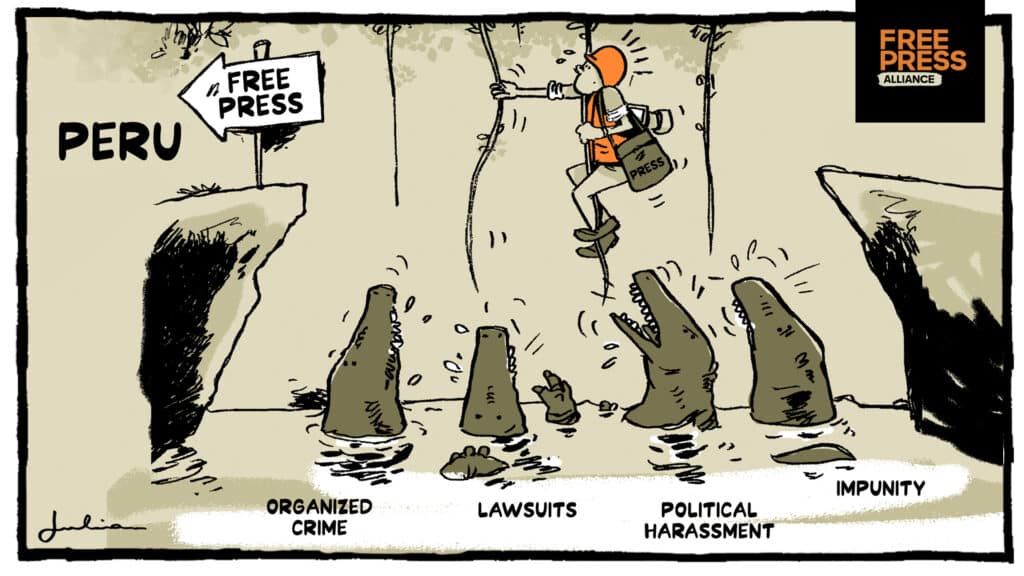
One of the most alarming developments in recent years has been the expansion of organized crime networks involved in drug trafficking, illegal mining, extortion, and environmental crimes. These groups have become increasingly powerful in several regions of the country, particularly outside Lima.
As criminal organizations expand their influence, journalists investigating these activities face enormous risks.
Reporters covering illegal mining operations, environmental destruction in the Amazon, narcotics trafficking, and local corruption often work with limited resources and little institutional protection. Many are freelancers or employees of small regional outlets that lack the legal and financial support available to major national media organizations.
The consequences have been deadly. According to recent reports by CPJ and the Instituto Prensa y Sociedad (IPYS), four journalists were killed in Peru during 2025, making it the deadliest year for Peruvian journalism in decades. The victims worked in regional areas outside the capital and were reporting on issues connected to corruption, criminal networks, and local power structures.
Peruvian journalists are also facing increasing levels of legal intimidation, surveillance, and judicial harassment. Press freedom groups have documented numerous cases in which reporters investigating corruption were subjected to lawsuits, criminal complaints, demands for private communications, or attempts to reveal confidential sources.
Investigative journalists have reported being targeted by legal actions shortly after publishing stories involving senior government officials or politically connected figures.
While such cases do not always result in convictions, critics argue that the process itself serves as punishment. Defending against lawsuits requires significant financial resources, time, and emotional energy, particularly for independent journalists and smaller media organizations.
This phenomenon, often described as “lawfare” against the press, has become a growing concern throughout Latin America.
The APCI law and fears of greater state control
In 2025, Peru enacted controversial modifications to the APCI law. Amnesty International warned that the legislation could undermine freedom of expression and freedom of association by expanding government oversight of organizations receiving international funding.
Many independent media outlets in Peru operate as nonprofits and rely on international funding to support investigative journalism projects. Under the new framework, organizations receiving foreign funding face increased reporting requirements and greater government oversight.
Amnesty International’s analysis argues that these measures create opportunities for political interference and bureaucratic pressure while increasing the vulnerability of media organizations that investigate government misconduct.
The legislation could discourage independent reporting by creating financial uncertainty and regulatory obstacles for smaller outlets already operating under difficult conditions.
Weak protection mechanisms and widespread impunity
Peru has established mechanisms intended to protect human rights defenders and journalists facing threats. However, press freedom organizations argue that these systems remain underfunded, reactive, and largely ineffective.
Many journalists express little confidence in state protection programs, particularly when threats originate from public officials or individuals with political connections.
At the same time, impunity remains one of the greatest challenges.
Investigations into attacks against journalists often move slowly, while prosecutions remain rare. The lack of accountability sends a dangerous message: those who threaten, harass, or attack journalists are unlikely to face consequences.
This environment of impunity not only endangers individual reporters but also encourages self-censorship. Journalists working in high-risk regions may avoid sensitive investigations altogether, fearing retaliation without protection.
A warning sign for democracy
The crisis facing Peruvian journalism is ultimately about more than the media itself.
Peru’s current trajectory demonstrates how democratic erosion often occurs gradually rather than through a single dramatic event. The weakening of institutions, attacks on oversight mechanisms, hostility toward critical reporting, and growing impunity for violence against journalists collectively create an environment in which press freedom becomes increasingly fragile.
The country still maintains independent media outlets, investigative reporting initiatives, and journalists committed to exposing abuses of power. However, press freedom organizations warn that these gains cannot be taken for granted.
Without stronger protections for journalists, greater accountability for attacks against the press, and renewed commitment to democratic institutions, Peru risks moving further toward a model in which independent journalism becomes increasingly dangerous and increasingly difficult to sustain.
The future of press freedom in Peru will depend not only on the resilience of its journalists but also on whether the country’s political institutions are willing to defend the fundamental democratic principle that a free press must be able to operate without fear.