
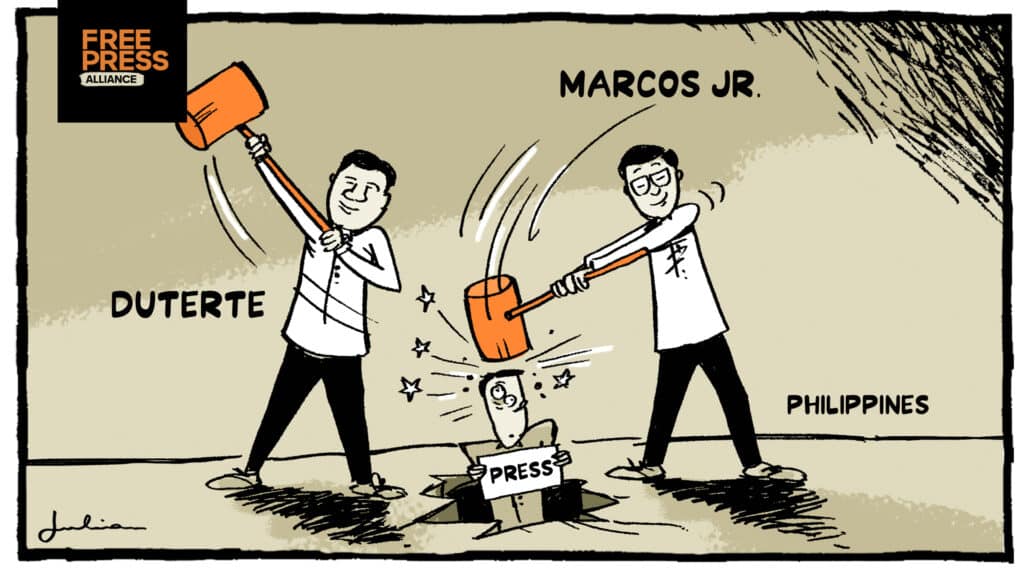
When Ferdinand “Bongbong” Marcos Jr. won the presidency in 2022, Filipino journalists were left asking a simple question: would he deal with the media any differently from Rodrigo Duterte? (ANU Philippines Institute) Four years later, the answer from press freedom monitors is mixed. Some things have genuinely changed. The tools that matter most to journalists’ day-to-day safety have largely not.
The headline numbers show ambiguity. In the 2026 World Press Freedom Index, the Philippines rose from 116th to 114th place among 180 countries. Yet its score of 46.97 out of 100 still places it in RSF’s “difficult” category, and the improvement came as global press freedom fell to its lowest level since 2001. A small climb in rank, in other words, is not the same as more freedom.
What has genuinely changed
The most visible difference is language. Duterte was openly hostile to reporters; the International Press Institute recalled that he called journalists “corrupt” and said they were not exempt from assassination. RSF named him a “press freedom predator” in 2021 (CMFR). Under Duterte, the country’s largest free TV and radio network was also shut down (ANU).
Marcos Jr. has not used that register. IPI noted that anti-press rhetoric from the top office lessened after he took office, and in August 2026 he told foreign correspondents in Manila that a president’s role is to defend press freedom, not diminish it (Daily Tribune).
There have also been judicial outcomes that press freedom advocates welcomed. In 2023, Nobel laureate Maria Ressa and Rappler were acquitted of the final tax charge brought under the previous government, following earlier acquittals in four of seven tax cases. The Hold the Line Coalition said the verdict showed it was possible for Marcos Jr. to reset the media repression he inherited.
What has stayed the same
The legal and institutional framework used against critics has endured. CMFR describes the Anti-Terrorism Law and the National Task Force to End Local Communist Armed Conflict (NTF-ELCAC) as the legal backbone of Duterte-era pressure on expression, and argues that Marcos Jr. continued the precedent. RSF’s 2026 assessment points the same way: it says terrorism charges and “red-tagging” remain the preferred means of silencing the press.
Cases begun under Duterte have also continued. IPI observed in 2023 that key cases against journalists and media houses carried over, including Frenchie Mae Cumpio’s detention and Ressa’s appeals. Access has not opened up either: analysts note that Marcos Jr. is largely inaccessible to the media and rarely takes questions, much as Duterte offered little easy access to reporters (CMFR).
The test case: Frenchie Mae Cumpio
No case captures the overlap between the two administrations better than Cumpio’s. The Tacloban-based community journalist was arrested on 7 February 2020, during the Duterte years, in a joint police and military raid (CMFR). On 22 January 2026, with Marcos Jr. in office, a Tacloban court convicted her of terrorism financing and sentenced her to 12 to 18 years, while acquitting her of illegal possession of firearms and explosives. She is described as the first Filipina journalist prosecuted under the terror financing law.
The two sides read the verdict very differently. The judge found the prosecution had established all elements of the offence, giving weight to the testimony of four former members of the New People’s Army (Philippine Daily Inquirer). Officials from the anti-insurgency task force welcomed the ruling and said the defendants were convicted for financing a terrorist group, while rights groups and the defense called the evidence fabricated (AP). Sixteen foreign embassies in Manila expressed outrage (Inquirer).
Two points are worth keeping apart. The conviction came from a court, not from a presidential order. But the arrest, the prosecution, and the legal tools behind it all belong to a system that outlasted the change of president.
What the numbers can and cannot tell us
Monitoring groups have documented a steady flow of incidents under both presidents. CMFR and the National Union of Journalists of the Philippines (NUJP) recorded 281 incidents of attacks and threats from June 2016 to April 2022 under Duterte. The NUJP had counted 242 alleged violations under Marcos Jr. as of April 2026. Spread over the length of each term, that works out, by our rough arithmetic, to about 48 incidents a year under Duterte and about 63 a year so far under Marcos Jr. CMFR also reported 75 violations in the first ten months of the Marcos Jr. presidency, more than in any single year it documented under Duterte.
These figures should be read with caution. They come from different monitors, cover different periods, and may use different definitions of an “incident.” They are better understood as evidence that pressure has not eased than as a precise measure of which president was worse.
On killings, the picture is somewhat less grim in tone but still serious. IPI counted three journalists killed in Marcos Jr.’s first year, including radio broadcaster Percival “Percy Lapid” Mabasa; an East Asia Forum analysis counts four killed under his administration as of late 2024, in a country where close to 200 journalists have died since 1986. One Daily Tribune columnist put it bluntly: not being killed is a low bar, not a real win.
A different style of pressure
Several observers argue that the method, not just the tone, has shifted. A Daily Tribune columnist contends that Marcos Jr. avoids open confrontation and lets time, distraction and disinformation do the work (an opinion piece, and one reading among several). CMFR points to vloggers and platforms such as TikTok as a newer element in the government’s messaging, and to a spike in online attacks on the media early in his term. In 2026 the Commission on Human Rights added that artificial intelligence poses new risks to press freedom.
A debate clouded by politics
The comparison between the two presidents is also shaped by their rivalry. Duterte has recently warned about deteriorating freedom of expression under Marcos Jr., but The Diplomat argues he lacks the credibility to champion free speech given his own record, and that both leaders weaponized laws that eroded civic space. The Commission on Human Rights has said there is little difference between the two in human rights violations. Any honest comparison must resist being drafted into one camp’s argument.
A fair verdict
Taken together, the evidence supports a two-part conclusion. Marcos Jr. deserves credit for ending the open vilification of journalists and for a period in which several high-profile Duterte-era cases against Rappler ended in acquittal. But the instruments that most endanger journalists, from terrorism-related charges and red-tagging to slow justice for killings, remain in place. As the Commission on Human Rights stressed this August, impunity for crimes against media workers perpetuates a dangerous cycle.
The Philippines’ rise to 114th place is real but modest. The test of this administration will be less about what it says on National Press Freedom Day than about whether the laws, prosecutions, and protections that shape a reporter’s everyday risk actually change.