As South Africa’s anti-migrant movement passed its self-declared June 30 deadline for undocumented foreigners to leave the country, journalists covering the unrest increasingly found themselves the targets of the very violence they were sent to document.
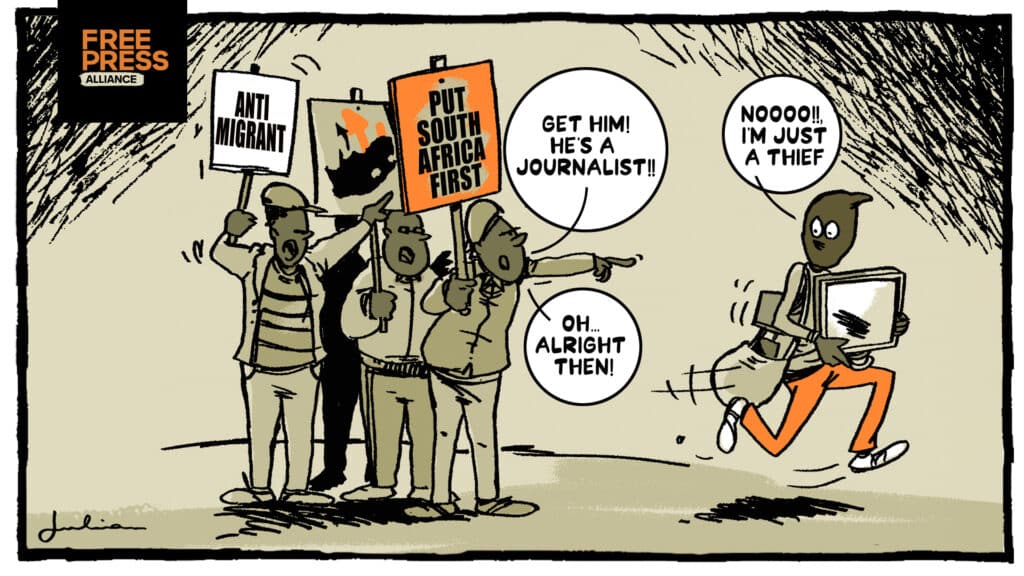
At least 15 journalists have been targeted across South Africa in recent months. News24 journalist Sakhiseni Nxumalo was threatened while filming an assault on a Zimbabwean man in Pietermaritzburg, with protesters accusing him of being a foreigner because of his skin tone and demanding he delete his footage. Days later, a News24 intern covering a demonstration in Boksburg was surrounded by protesters carrying whips who questioned his nationality and forced him to sing the national anthem to prove he was South African.
The pattern extends beyond physical intimidation. Journalists at several major outlets, including Business Day, GroundUp, the Sowetan, and the South African Broadcasting Corporation, have faced online harassment, doxxing, and accusations of bias after publishing coverage critical of anti-migrant groups. Some chapters of the movement have gone further, publicly naming and posting photographs of journalists on social media and urging followers to be on the lookout for them.
More Journalists Caught in the Crossfire
The 15 documented cases span at least four provinces, the Eastern Cape, KwaZulu-Natal, Western Cape, and Gauteng, according to the South African National Editors’ Forum (SANEF), which said journalists are not being targeted for illegal acts but for exposing xenophobic rhetoric and documenting the violence that accompanies the protests. In Durban, a German broadcaster DW correspondent and her camera operator were physically manhandled and had their camera covered by bodyguards after asking questions of an M&M movement leader during a live broadcast, forcing police to intervene. In Johannesburg, reporters covering demonstrations outside the Gauteng Legislature described being surrounded and pressured to stop filming. Getty Images photographer Wesley Fester and AFP’s Saamwiet Moos were both named and pictured in a movement Facebook post accusing them of trying to sabotage a Cape Town march, an incident CPJ documented as part of a broader pattern of movement supporters using social media to identify reporters in the field.
Beyond street-level confrontations, several editors have faced targeted campaigns meant to intimidate them into silence. After criticizing the movement’s tactics in a column, Sowetan editor-in-chief Sibongakonke Shoba had photos of himself and his family circulated online, and the movement’s founder sent lawyers demanding the column be retracted, a demand Shoba’s paper refused. SANEF called the episode a dangerous attempt to intimidate a journalist by targeting his family, and reaffirmed that xenophobia has no place in South African society.
A Movement Built on Racialized Suspicion
The wave of intimidation is tied to a broader campaign led by groups such as March and March and Operation Dudula, which have blamed undocumented migrants for unemployment, crime, and strain on public services. Reporting shows the hostility disproportionately falls on Black African migrants from countries like Zimbabwe, Mozambique, and Malawi, while wealthier foreigners and white residents are rarely targeted, a dynamic one Nigerian business owner described as “heavily racialized and classed.” That same dynamic has bled into how journalists are treated in the field: reporters have been accused of being undocumented migrants themselves, based on nothing more than their complexion.
Operation Dudula, whose name means “to push out” in isiZulu, began in Soweto in June 2021 out of an earlier online movement called Put South Africa First, which had formed during the COVID-19 pandemic amid frustration that migrant-run businesses stayed open while locals struggled economically. Its early actions included raiding suspected drug dens and evicting migrants from social housing. Since 2021, roughly a third of South Africans have been unemployed, a rate researchers say drives the scapegoating of the country’s most vulnerable residents rather than addressing the structural causes of joblessness. In April 2022, President Ramaphosa denounced Operation Dudula as illegal vigilantism, though the group has since registered as a political party and continues to organize nationally.
This is not South Africa’s first eruption of xenophobic violence. In May 2008, attacks that began in Alexandra township spread nationwide, and mobs hunted migrants with iron bars and machetes, killing more than 60 people and displacing tens of thousands before soldiers were deployed to restore order. Deadly episodes flared again in 2015 and 2019, and in 2022 the killing of a Zimbabwean man dragged from a shelter and set alight in Diepsloot prompted United Nations experts to warn that South Africa was “on the precipice of explosive violence.” A 2020 Human Rights Watch investigation found that a national action plan adopted in 2019 to combat xenophobia had had little practical effect, citing patterns of official indifference and low rates of prosecution for attacks on foreign nationals.
Government and Political Response
President Cyril Ramaphosa’s government has rejected the deadline as having no legal standing and has placed the police on high alert, but has stopped short of a decisive crackdown on the vigilante campaigns themselves. Ramaphosa has said the government welcomed assurances that planned protests would remain peaceful, while warning that violence would not be justified under any circumstances. Meanwhile, thousands of migrants, an estimated 38,000 Malawians and over 60,000 Zimbabweans, have already returned to their home countries rather than risk the violence.
The political response has been divided. At least two opposition parties in Parliament have backed the movement’s demands for deportation, and the uMkhonto weSizwe Party (MKP), linked to former president Jacob Zuma, publicly attacked Business Day political editor Hajra Omarjee as a propagandist after she reported on warnings of unrest tied to the deadline. SANEF condemned the party’s language as part of a dangerous pattern of political rhetoric feeding hostility toward journalists and called on MKP and March and March leaders to halt the harassment. At its annual general meeting in early July, SANEF’s delegates went further, flagging growing harassment and cyberbullying of journalists covering the migrant protests as a new front-line threat to press freedom heading into the country’s November local government elections and announced additional journalist-safety training ahead of the vote.
For press freedom advocates, the targeting of journalists during this crisis raises a familiar and urgent concern: when reporters are attacked for documenting ethnic or nationalist violence, the public’s ability to hold power accountable erodes at precisely the moment it’s needed most. CPJ, together with seven other media freedom organizations, issued a joint statement calling on movement leaders to end unlawful action and stop threatening journalists, and urging South African authorities to guarantee journalists’ safety and prosecute those responsible. As of early July, no arrests had been made despite formal complaints and video evidence documenting assaults on at least two journalists.