Hondurans went to the polls on Sunday in a presidential election overshadowed by allegations of fraud, political pressure, and a deteriorating environment for independent journalism. Preliminary results point to entrepreneur Nasry “Tito” Asfura as the winner, despite pre-election polls placing him in third position. The vote took an even sharper turn when U.S. President Donald Trump threatened to cut financial aid to Honduras if Asfura did not win, an unprecedented intervention less than 48 hours before the election day.
But beyond political tensions or claims of external interference, the most alarming development has been the hostile and dangerous climate faced by the Honduran press in the weeks leading up to the vote.
Escalating hostility toward the media
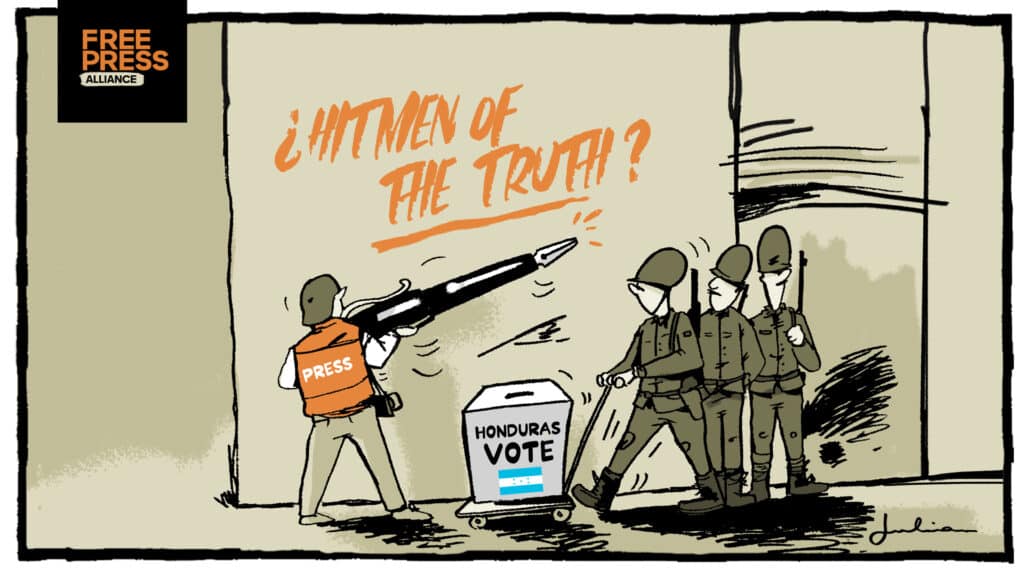
In the run-up to the election, the Honduran Armed Forces’ high command issued a series of aggressive and deeply concerning public statements targeting journalists and media outlets. Military leaders accused reporters of conducting“ media campaigns disguised as journalistic coverage”, suggesting that the press sought to damage the institution’s credibility.
These remarks were accompanied by insinuations that journalists were part of a “network of public and private actors mixed with organized crime structures.” An official Armed Forces publication even ran a front-page piece titled “Hitmen of the Truth,” accusing three journalists of being the enemies of the state, a move condemned by press freedom groups as stigmatization and criminalization of journalistic work.
A pattern of institutional intimidation
These recent statements are part of a broader pattern of institutional pressure documented throughout the year: threats compelling media outlets to reveal sources, judicial harassment, digital attacks, including the hacking of newsroom social media accounts, and repeated public attempts to discredit investigative reporting.
The independent outlet Criterio.hn has publicly denounced the hacking of its social media accounts and official demands from the Public Prosecutor’s Office to disclose confidential sources, actions described by local and regional free-expression organizations as clear intimidation.
Impact on journalists and newsrooms
The combination of military rhetoric, prosecutorial pressure, and digital attacks has direct and measurable effects on journalists’ safety and editorial independence:
- Self-censorship: when the armed forces and state institutions label reporting as criminal or link journalists to organized crime, the resulting chilling effect encourages self-censorship on politically sensitive issues.
- Legal and administrative pressure: repeated to reveal sources undermine the confidentiality necessary for investigative reporting on corruption and illicit networks. Forced disclosure requests violate Honduran and international standards on the protection of journalistic sources.
- Digital insecurity: hacking campaigns and coordinated online attacks erode an outlet’s ability to reach audiences and can be used to spread disinformation or destroy credibility. Criterio.hn, one of the targeted outlets, reported such attacks alongside visits from prosecutorial staff demanding source information.
Together, these pressures weaken the media’s capacity to provide the independent scrutiny essential for free and fair elections.
Impact on electoral transparency and public trust
A free press is a cornerstone of electoral accountability. When journalists are intimidated, voters receive less reliable information, and the space for public debate shrinks.
In Honduras, the pre-election environment, including controversies over military custodianship of ballots and a slow, contested counting process, has heightened public suspicion about the impartiality of institutions overseeing the vote. Allegations of fraud and the political weight of an external actor publicly threatening aid have deepened these concerns.
Early reports of close vote counts among frontrunners have led rival campaigns to warn of manipulation and question the legitimacy of preliminary results, further eroding public trust.
International reaction and regional bodies
Regional and international organizations have publicly condemned the harassment of Honduran journalists. Inter-American and press-freedom groups have issued statements expressing “serious international concern” about stigmatizing rhetoric from security forces and judicial actions that threaten journalistic confidentiality. Several NGOs, including CPJ, RSF and PEN, along with hemispheric press organizations such as IAPA, have called on authorities to end judicial harassment and protect journalists.
These statements add diplomatic pressure but have not yet resulted in concrete measures to reverse the pattern of intimidation.
Legal and historical context
Honduras has a recent history of contested elections, a powerful security apparatus, and weak practical protections for media independence. Attempts by authorities to compel source disclosure, combined with vague cybercrime and national security provisions, create tools that can be used to punish critical reporting.
Although domestic laws formally guarantee press freedom and source protection, enforcement remains inconsistent, particularly when political, military, or security interests are involved. International standards under the Inter-American and UN systems prohibit state stigmatization of the press and strongly protect journalists’ source confidentiality, obligations that Honduras is required to uphold.
Conclusion
The recent elections in Honduras took place in an environment marked by military rhetoric, prosecutorial pressure, and digital attacks that constrained independent journalism at a critical democratic moment. Restoring public trust and ensuring credible electoral outcomes will require immediate steps to halt stigmatization, implement robust protection for journalistic sources, and strengthen monitoring by regional and international bodies. Without these measures, the space for impartial reporting, and with it, the foundations of democratic accountability, will continue to shrink.