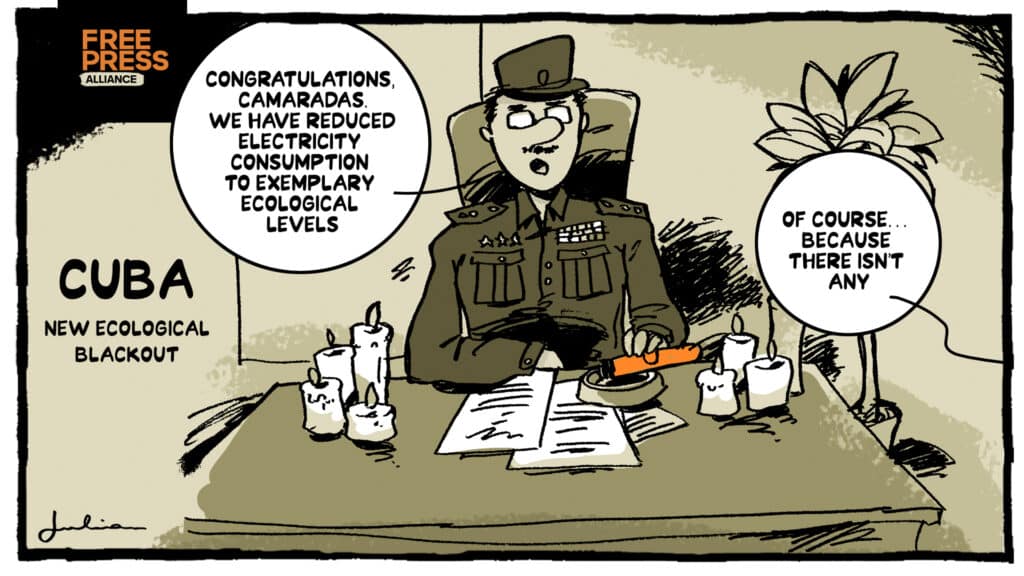
Cuba’s worsening energy crisis has triggered a renewed wave of protests across the island, driven by prolonged blackouts, fuel shortages, and deteriorating living conditions. In response to growing public unrest, Cuban authorities have intensified efforts to control information, particularly by targeting independent journalists attempting to cover these events.
Recent reports indicate a pattern of mobility restrictions, surveillance, and intimidation, suggesting a coordinated strategy not only to contain protests but also to limit their visibility domestically and internationally.
Energy crisis as a driver of unrest
Cuba is facing one of its most severe economic and energy crises in decades, marked by recurring blackouts and fuel shortages. These conditions have fueled localized protests across multiple provinces, with citizens demanding basic services and improved living standards.
According to the Inter-American Commission on Human Rights, authorities have responded with repression and narrative control, framing protests as threats to national stability while limiting independent coverage of events.
Blocking coverage at the source
A key tactic employed by Cuban authorities is restricting journalists’ movement during protest periods.
Reporters Without Borders (RSF) documented in March 2026 that several independent journalists, including Yoani Sánchez, Camila Acosta, and Mabel Páez, were placed under police surveillance or de facto house arrest while attempting to cover protests related to the energy crisis.
These restrictions often involve:
- Police presence outside journalists’ homes.
- Temporary detentions to prevent movement.
- Arbitrary limitations on travel during periods of unrest.
By preventing journalists from reaching protest sites, authorities effectively suppress real-time, on-the-ground reporting.
Surveillance and digital monitoring
Surveillance, both physical and digital, remains central to Cuba’s strategy for controlling information.
The Inter-American Commission on Human Rights has documented systematic surveillance, internet disruptions, interrogations, and house arrests targeting journalists and activists in Cuba. These measures are often deployed during periods of heightened social tension.
Cuba’s state-controlled telecommunications infrastructure enables authorities to:
- Monitor communications and online activity.
- Restrict internet access during protests.
- Limit the dissemination of independent reporting.
Freedom House has also noted the government’s use of connectivity restrictions and digital repression to control public discourse, particularly during protests.
Intimidation and legal pressure on independent journalists
Mobility restrictions and surveillance are frequently accompanied by intimidation and legal harassment.
The Committee to Protect Journalists (CPJ) has reported arrests and detentions of independent journalists amid ongoing repression of the non-state press. Journalists contributing to independent or foreign outlets are particularly vulnerable.
Similarly, Human Rights Watch (HRW) notes that the Cuban government maintains strict control over media and routinely targets critics and independent journalists, using vague legal provisions such as “public disorder” or “contempt” to justify repression.
These tactics often include:
- Interrogations by state security agents.
- Threats of prosecution.
- Pressure on family members.
- Confiscation of equipment.
A strategy of preemptive repression
What distinguishes the current wave of repression is its increasingly preemptive nature.
Rather than reacting after protests gain momentum, authorities are identifying journalists likely to cover unrest and restricting them in advance. This strategy reflects lessons learned from previous protest waves, particularly those that gained significant international visibility through social media and independent reporting.
According to Reporters Without Borders, Cuba remains one of the most restrictive environments for journalism in the region, where independent reporting operates under constant threat.
Exile and the erosion of independent media
Sustained repression has led to a growing exodus of journalists.
The Global Investigative Journalism Network reports that dozens of Cuban journalists have been forced into exile in recent years due to harassment, surveillance, and legal pressure.
This trend weakens the domestic media landscape and shifts independent reporting abroad, reducing the availability of on-the-ground coverage during crises such as the current energy shortages.
Implications: Information control and public accountability
The combined use of mobility restrictions, surveillance, and intimidation has far-reaching consequences:
- Information vacuum: Citizens are left with limited access to verified, independent reporting.
- Reduced accountability: Authorities face less scrutiny over both the energy crisis and protest responses.
- Normalization of repression: These tactics risk becoming standard during any period of unrest.
Freedom House consistently ranks Cuba among the most restrictive countries in the world for political rights and civil liberties, including freedom of expression.
Conclusion: Controlling the narrative in times of crisis
Cuba’s response to protests over its energy crisis highlights a broader reality: information control is a central pillar of political control.
By restricting journalists’ mobility, expanding surveillance, and applying legal pressure, authorities are not only limiting coverage but also actively shaping the narrative around public dissent.
As economic conditions continue to deteriorate, the likelihood of further protests remains high. Whether these developments are documented transparently will depend on the ability of independent journalists to operate despite increasing restrictions, and on continued international attention to press freedom in Cuba.