
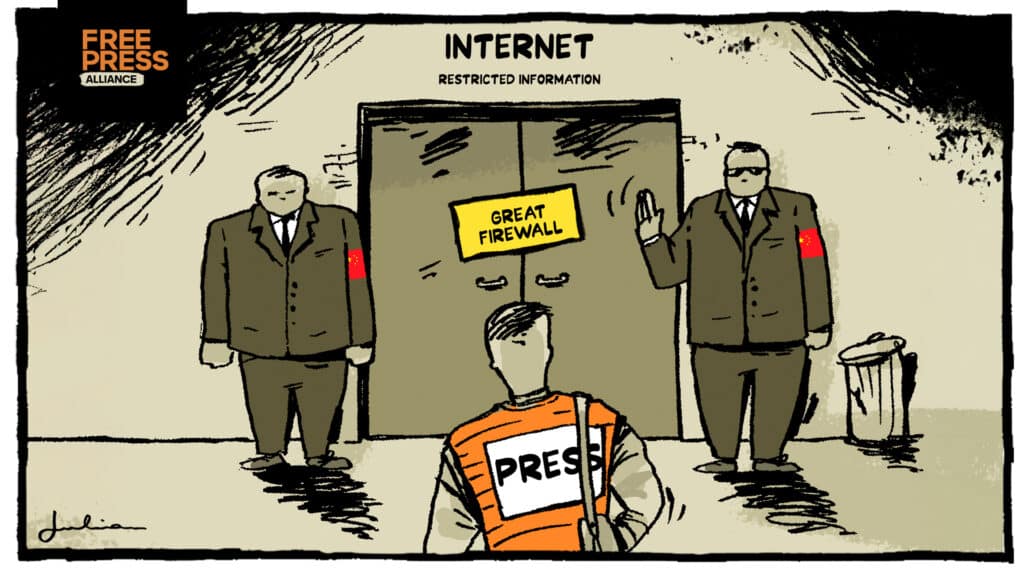
In the digital age, information control has become one of the most powerful tools of governance. Nowhere is this more evident than in China, where the state has developed one of the most sophisticated systems of digital censorship and surveillance in the world. Often referred to as the “Great Firewall,” this system is not a single mechanism but a multilayered architecture that combines legal regulation, technological filtering, corporate compliance, and artificial intelligence.
China’s model represents a shift from traditional censorship toward what scholars describe as digital authoritarianism, a system in which the state not only restricts information but actively shapes the digital environment to maintain political control.
The architecture of control: The great firewall
China’s system of internet control is deeply embedded in its infrastructure. According to Human Rights Watch, censorship is “built into all layers” of the country’s internet architecture, targeting the flow of information between domestic and global networks.
At the core of China’s information control strategy is the Great Firewall, a vast regulatory and technological system designed to monitor, filter, and block online content.
Developed in 1998 as part of the “Golden Shield Project,” the system was created to manage the rapid expansion of internet access while preserving political stability.
Today, the system operates through a combination of:
- Technical filtering: Blocking foreign websites, IP addresses, and keywords.
- Network interference: Techniques such as DNS poisoning and TCP reset attacks disrupt access to banned content.
- Deep Packet Inspection (DPI): Allows authorities to analyze data traffic in real time.
As a result, major global platforms, including Google, Facebook, YouTube, and many international news outlets, are inaccessible within China.
This system effectively creates a “parallel internet”, where domestic platforms such as WeChat, Weibo, and Baidu replace global alternatives while remaining subject to strict state oversight.
State control meets corporate responsibility
A defining feature of China’s digital governance model is the integration of private companies into the censorship apparatus.
Research by Human Rights Watch highlights how both domestic and international tech firms have historically participated in filtering politically sensitive content, often proactively removing material to comply with government expectations.
This has led to a hybrid system where:
- The state sets the rules.
- Private companies enforce them.
- Automated systems scale enforcement.
Major tech firms act as intermediaries, embedding censorship into platform design. This shifts part of the responsibility for information control from the state to the private sector, while maintaining centralized political authority.
From censorship to surveillance
China’s system extends beyond blocking content to monitoring user behavior.
The same infrastructure that filters information also enables surveillance, allowing authorities to track online activity and identify politically sensitive behavior. Academic studies show that the system can analyze vast volumes of internet traffic and even result in “overblocking,” where neutral content is restricted due to algorithmic filtering.
Authorities can track user activity through:
- Platform data collection.
- Real-time traffic monitoring.
- Integration with broader surveillance systems.
Recent developments show the increasing use of artificial intelligence to enhance these capabilities. AI systems can identify sensitive content, flag users, and automate moderation at scale, significantly expanding the reach and efficiency of censorship.
This evolution marks a transition from reactive censorship to predictive control, where potential dissent can be identified and suppressed before it spreads.
Intensification and localized control
While China’s censorship system is already extensive, recent research suggests it is becoming even more granular.
Recent findings indicate that regional authorities are developing their own censorship mechanisms, sometimes exceeding national-level restrictions. In provinces such as Henan, local systems have blocked significantly more websites than the central firewall, suggesting decentralized but intensified enforcement.
This suggests that China’s digital control system is not static but continuously evolving, adapting to new technologies and political priorities.
Global Implications: Exporting digital authoritarianism
China’s model of internet governance is increasingly influencing other countries.
Reports indicate that Chinese firms are exporting censorship and surveillance technologies abroad, enabling other governments to replicate similar systems of control.
This has significant implications for global press freedom:
- It lowers the technical barrier for digital repression.
- It normalizes state control over online information.
- It contributes to the global decline in internet freedom.
China’s approach is no longer confined within its borders; it is becoming a template for digital governance in authoritarian contexts.
Impact on press freedom
For journalists, China’s system presents structural barriers to independent reporting:
- Restricted access to information limits reporting accuracy.
- Censorship of sensitive topics shapes public discourse.
- Surveillance risks discourage investigative journalism.
Many controversial events are excluded from public visibility, preventing citizens from accessing independent perspectives and constraining the role of the press as a watchdog.
This environment not only affects domestic journalism but also impacts foreign correspondents, whose reporting is often restricted or blocked.
Conclusion
China’s system of total information control represents one of the most advanced forms of digital governance in the world. By combining technological infrastructure, legal frameworks, and corporate enforcement, the state has created a tightly controlled information ecosystem.
In the digital age, power is increasingly defined by control over data and narratives. China’s model demonstrates how this control can be institutionalized at scale, raising critical questions about the future of press freedom, the role of technology, and the global trajectory of digital rights.