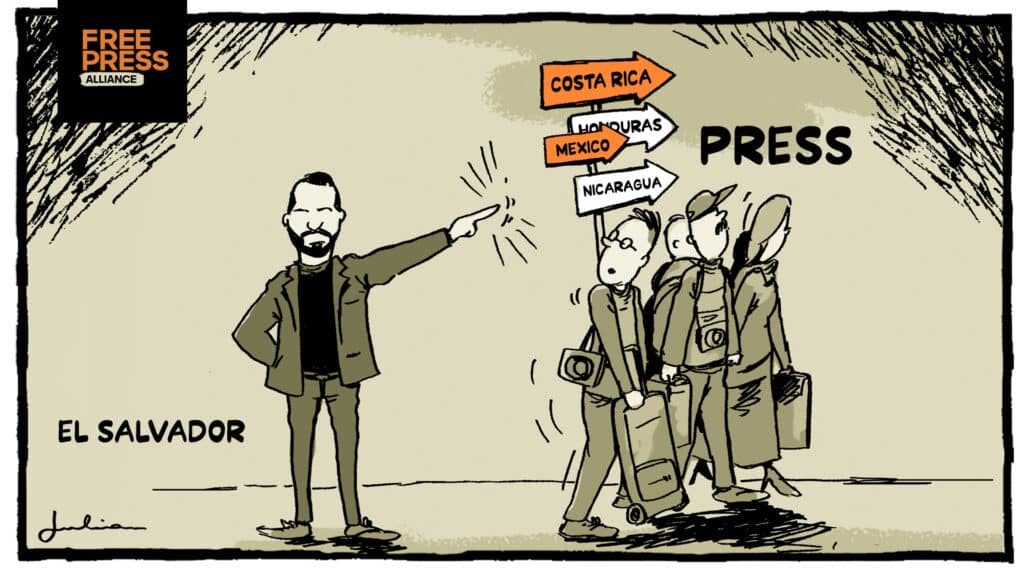
For years, El Salvador under President Nayib Bukele has been presented abroad as a security success story. For the country’s independent press, the same period has meant surveillance, legal and financial pressure, and an unprecedented departure of reporters from the country. In its 2026 index, Reporters Without Borders (RSF) placed El Salvador 143rd out of 180 countries, down eight places in a year and 74 places since Bukele took office in 2019. The Association of Journalists of El Salvador (APES) puts the longer fall at 105 places since 2014.
This analysis traces the main instruments of pressure, sets out how the government answers its critics, and flags where the available figures differ.
A state of exception and a hostile climate
The backdrop is the state of exception introduced in 2022 to fight gangs. The Committee to Protect Journalists (CPJ) told a U.S. congressional commission in April 2026 that the measures, originally justified as a response to gang violence, have been continuously renewed and repurposed in ways that curb civil liberties. A 2024 CPJ and Inter-American Press Association mission found a growing culture of silence, with reporters who cover crime fearing they could be targeted.
APES recorded 789 attacks and violations against the press in 2024, a 154 percent increase on the 311 documented in 2023 (see Human Rights Watch’s World Report 2026). Harassment has also been verbal and online: In 2020 Bukele accused leading outlets of lying and of waging an orchestrated political campaign, and APES has documented a large volume of insults aimed at journalists, much of it from officials and supporters.
Surveillance has been part of the picture. Citizen Lab concluded that at least 35 people linked to outlets including El Faro, GatoEncerrado and La Prensa Gráfica were hacked with Pegasus spyware, a finding reported again in coverage of the 2026 crackdown.
The Foreign Agents Law
The most consequential legal step came on 20 May 2025, when the Legislative Assembly approved the Foreign Agents Law, by 58 of 60 votes. It requires individuals and organizations that receive foreign funding to register with the government and pay a 30 percent tax on those funds. RSF notes that it allows fines of up to US$250,000, and CPJ warns that because it also applies to individuals, freelance journalists, academics and trainers who receive stipends from abroad could be labeled foreign agents.
The economic argument matters as much as the legal one. Independent outlets say domestic advertisers are afraid of retaliation, which makes international donors essential. CPJ quotes a media representative saying the law targets exactly that lifeline. Human Rights Watch has argued the law violates El Salvador’s obligations under international human rights law. A labor rights group has asked the Supreme Court to strike it down, according to the Associated Press.
The consequences for the press ecosystem were quick. The human rights group Cristosal announced it was leaving the country in July 2025, and APES moved its legal status out of El Salvador citing the law. CIVICUS added El Salvador to its Monitor Watchlist in July 2025.
El Faro and the exile wave
El Faro, the country’s best-known investigative outlet, moved its administrative and legal structure to Costa Rica in 2023, and its staff have been working in exile for the past year, according to the Tico Times. In May 2026 the outlet said the government had frozen assets belonging to its partners in retaliation for reporting on alleged dealings between the president and gang members. That is El Faro’s account; the report links the action to a recently published documentary on those allegations.
The exile figures vary by source and period, but all point the same way. APES and the Central American Network of Journalists counted at least 47 journalists leaving between May and July 2025. APES’s annual report later put the 2025 total at 53 communicators, which it described as the largest wave of journalist exile since the civil war ended. CPJ’s own research counts at least 40. Differences in methodology and timeframe likely explain the gap, so editors citing a number should name its source.
First-person accounts show what “preventive exile” looks like in practice. An El Faro journalist writing in The Dial describes colleagues leaving after a source’s warning that authorities were coming for them, and the expulsion of two foreign reporters on the grounds that they could not prove they were journalists.
The government’s position
Salvadoran authorities reject the characterization. Government representatives have told CPJ that press freedom is respected and that no journalists have been killed or imprisoned under the state of exception. CPJ’s April 2026 submission acknowledges that claim and argues that its research points the other way, citing exile, surveillance and self-censorship rather than detentions. Bukele has also defended the Foreign Agents Law and said he does not care if he is called a dictator, pointing to the country’s gang violence. Bukele has compared the law to the U.S. Foreign Agents Registration Act, while the bill also drew comparisons to Nicaragua’s 2020 law among press freedom groups.
The government’s security record is a central part of its domestic standing, and the pressure on the press has to be read alongside it. The core question for press freedom groups is narrower: whether independent reporting can continue to operate, from inside or outside the country, without being treated as a threat.
What to watch
Three things will shape the next phase. First, how the Foreign Agents Law is applied, and whether the Supreme Court acts on challenges to it. Second, whether exiled outlets such as El Faro can keep reaching Salvadoran audiences and sustain themselves financially. Third, the capture of the information space from the other side: the State Media Monitor maps five state-linked outlets, all classed as state-controlled or captured, leaving little independent broadcast or print capacity inside the country.
The pattern is one that press freedom monitors recognize from elsewhere in the region. As APES’s Hugo Sánchez told LatAm Journalism Review, Nicaraguan colleagues have warned that “where you are now, we once were”.
Sources
- RSF, 2026 World Press Freedom Index – The Americas
- CPJ, Press freedom in El Salvador (testimony, 16 April 2026)
- CPJ, Salvadoran congress approves ‘foreign agents’ law (30 May 2025)
- CPJ, A ‘culture of silence’ threatens press freedom (October 2024)
- RSF, The independent press under siege in El Salvador
- Human Rights Watch, World Report 2026: El Salvador (via ecoi.net)
- LatAm Journalism Review, exodus of journalists (August 2025)
- Tico Times, El Faro asset freeze report (7 May 2026)
- CIVICUS Monitor Watchlist, El Salvador (July 2025)
- The Dial, Fleeing Bukele