
In little more than a week, Turkish authorities jailed three journalists, placed two more under house arrest and sued others for damages. The common thread: reporting that came too close to people in power.
Two journalists are in pretrial detention in Istanbul and two more are confined to their homes after reporting on Turkey’s investment fund scandal, in a crackdown the Committee to Protect Journalists (CPJ) says has brought the country to “a crisis point.”
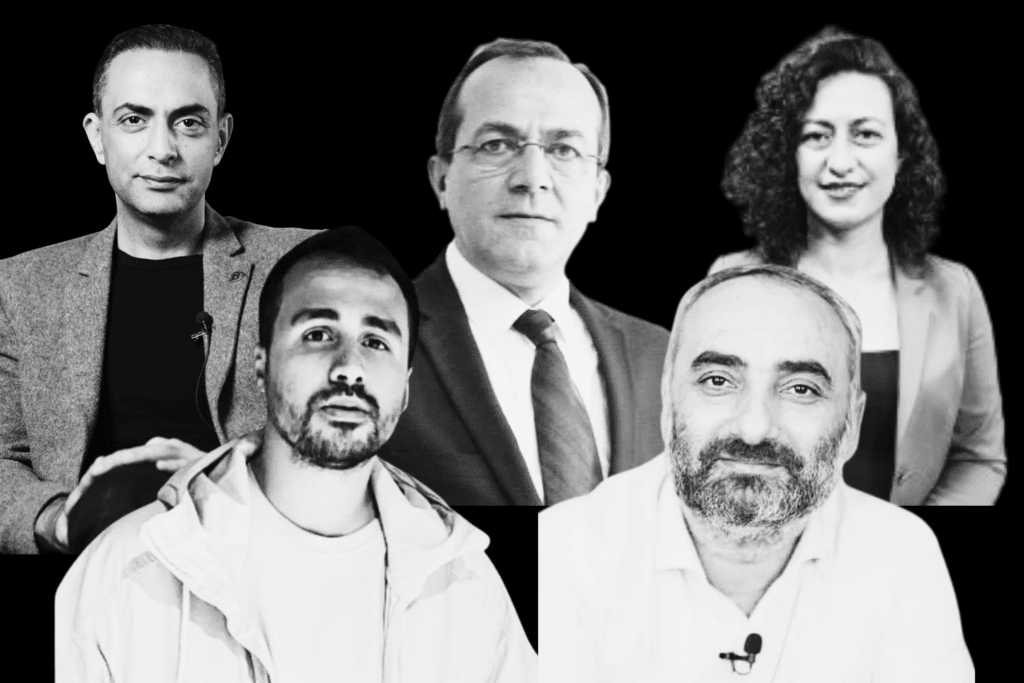
Mustafa Balcı, an editor at the opposition-leaning daily Sözcü, and Şaban Sevinç, editor-in-chief of the online channel Bizim TV, were detained on the night of 8 October and jailed pending trial by an Istanbul court the next day. Both are accused of “publicly disseminating misleading information” under Article 217/A of the Turkish Penal Code, the so-called disinformation law, which carries a prison sentence of one to three years.
On the same day, police questioned İsmail Saymaz and Murat Ağırel over their appearance on a 7 October Sözcü TV broadcast. A court released them under judicial control, with a foreign travel ban and regular police check-ins. After prosecutors objected, a second court placed both under house arrest on 10 October.
What they reported
The arrests stem from coverage of a crisis that erupted in mid-September, when several investment funds were unable to pay investors seeking to withdraw their money. On 17 September, the Capital Markets Board ordered the liquidation of 131 funds run by seven companies, affecting more than 455,000 investors. Investigators are now examining whether some investors sold their holdings just before the collapse became public, and whether they had warning.
That question has made the scandal politically explosive. Balcı had posted a photo on X that he said showed Ömer Çelik, spokesman for the ruling Justice and Development Party (AKP), at an August concert in Bodrum, seated one row away from Osman Arıkan Nacar, a figure named in the fund investigation. Balcı has said the photo had already been published and that his post presented the claims as allegations. The suggested link between the two men has not been independently verified.
The case against Ağırel followed a criminal complaint from Trade Minister Ömer Bolat. On air, Ağırel had relayed reports that Bolat was among privileged investors who pulled their money out before authorities intervened, stressing that he was passing on allegations rather than stating facts. Bolat denies the claims and calls them defamatory. Saymaz says he did not make the allegation himself.
A warning, then arrests
The arrests followed a warning on 8 October from Faruk Acar, the AKP deputy chair responsible for publicity and media, who threatened journalists who report “false news” in posts on X. AKP Secretary-General Eyyüp Kadir İnan has since accused the opposition and the media of spreading a “web of lies” and promised to hold critics legally accountable.
The party is pursuing critics in the civil courts too. On 13 October it emerged that the AKP is seeking 1.6 million lira (about $32,400) in damages from journalists Timur Soykan and Şaban Sevinç, the broadcaster BirGün TV and an opposition spokesman over their coverage and criticism of the scandal. “No claim for damages can take precedence over our responsibility to the public,” said Emre Yıldırım, BirGün TV’s broadcasting coordinator.
A separate case, the same climate
The fund-scandal arrests came days after another veteran reporter was jailed. Derya Okatan, who most recently worked for TELE1, an independent broadcaster since taken over by the state, was detained at her home in Ankara on 2 October and jailed pending trial in Istanbul the same day on suspicion of obtaining classified state documents. Under Article 327 of the Penal Code, she faces three to eight years in prison if convicted.
Authorities say nearly 300 classified files were found on her hard drive. Her lawyer, Ziya Ergin, points out that police had already seized the same drive in 2019 and made a digital copy of it. In a message from prison, Okatan said she did not know when the files were placed on the drive, or by whom. CPJ has called for her immediate release while the hardware is forensically examined.
A law built for this
Turkey introduced Article 217/A in October 2022. Press freedom groups warned at the time that its broad wording would let prosecutors target public-interest reporting. The record since then bears that out: according to CPJ, citing the monitoring group Veriler Ne Diyor, at least 83 journalists faced 114 charges under the law between October 2022 and April 2026. CPJ counts at least 22 journalists arrested or detained under it so far this year alone. Authorities have also blocked access to thousands of social media accounts belonging to journalists and human rights defenders.
“We are reaching a crisis point,” said Özgür Öğret, CPJ’s Turkey representative, who called for every journalist jailed or under house arrest to be freed and for the disinformation law to be abolished without delay.
Why it matters
The fund collapse touches nearly half a million savers. Who knew what, and when, is exactly the kind of question journalism exists to ask. When reporting on that question is treated as a crime, and when the officials named in that reporting are the ones filing complaints, a law sold as protecting the public from falsehoods ends up protecting the powerful from scrutiny.