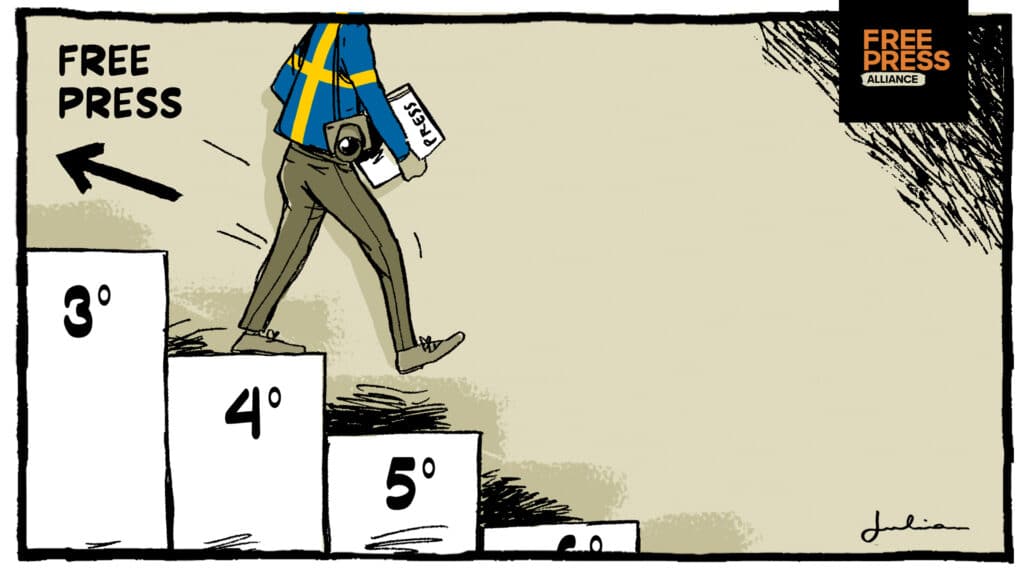
On paper, Sweden looks like one of the safest countries in the world to be a journalist. In Reporters Without Borders’ 2026 World Press Freedom Index, the country ranks 5th out of 180 nations, a mark most governments would envy. But a new report released by RSF just days before Sweden’s 13 September general election tells a more complicated story: one of quiet erosion, growing hostility toward reporters, and a public-access tradition under strain.
The report, titled “Closed Doors: Local Journalists on Press Freedom Challenges in the 2026 Election Year,” surveyed 25 permanently employed journalists working in local and regional Swedish newsrooms between March and May 2026. It does not claim to be statistically representative of the profession as a whole. But the pattern it documents is consistent enough to be alarming: transparency is shrinking, harassment is common, and many journalists expect things to get worse, not better.
A Ranking That Masks a Slide
The 5th-place finish is itself a step down. Sweden held 4th place in RSF’s 2025 Index and 3rd place the year before that, according to RSF’s own country profile, meaning the country has slipped in the ranking two years running even as it remains near the top of the global table. RSF attributes part of that continued high standing to Sweden’s status as the first country in the world to adopt a press freedom law in 1766, a legal foundation that still guarantees source protection and public access to government records.
That history is precisely what makes the new findings land hard. As RSF Sweden spokesperson Erik Larsson put it in the report, the principle of public access to official documents is “perhaps the most serious warning sign”, not because it has been abolished, but because it is being worn down one small obstacle at a time.
What Journalists Are Actually Reporting
The numbers in “Closed Doors” are stark for a country with Sweden’s reputation:
• 80% of journalists surveyed said authorities and public bodies have become less open over the past five years.
• 84% experienced an authority making it harder to access documents or information in the past year, through redactions, delays, or high fees.
• 64% said they were personally subjected to threats or harassment in the past year.
• 64% believe press freedom has declined over the past five years, and 60% expect further deterioration.
Some of the cases documented go beyond bureaucratic friction. One reporter in southern Sweden was confronted by armed men while covering a neo-Nazi roadblock and later found a knife-pierced note reading “We know where you live” on his front door, according to the RSF report; his personal details were subsequently given special legal protection for five years. In another case, an opinion editor in northern Sweden was targeted by a poster campaign bearing her photo and misogynistic slurs, which contributed to her taking sick leave.
These are not isolated incidents in Swedish political history. During the country’s 2022 general election, RSF publicly rebuked the Sweden Democrats, now the country’s second-largest party, after its chief of staff spoke of “pushing journalists around” and the party denied election-night access to a list of outlets, including Le Monde, the BBC, and several left-leaning Swedish publications. The Local Sweden reported at the time that RSF Sweden’s president called the comments “extremely worrying” given that the party’s role is to hold power to account, not obstruct those who scrutinize it. Four years later, the pattern described in “Closed Doors” access curtailed, hostility normalized, reads less like an isolated flashpoint and more like a trend.
Why the Timing Matters
RSF released the report deliberately ahead of the 13 September vote, in which Swedes are electing all 349 members of the Riksdag alongside regional and municipal councils, per election details published by Sweden’s Election Authority. Pre-election polling tracked by Wikipedia’s aggregation of Swedish opinion surveys showed a tight race between the governing centre-right coalition and a resurgent Social Democratic-led opposition, the kind of competitive environment in which, RSF’s report warns, access to information and freedom from intimidation matter most and are hardest to guarantee.
Journalists surveyed for the report ranked disinformation and propaganda alongside political interference, restrictive legislation, and the threat of lawsuits as the top dangers facing their profession going forward. RSF’s report specifically flags the risk posed by generative AI, which it says makes it faster and cheaper to produce manipulated content and coordinated influence campaigns aimed at undermining trust in independent reporting.
RSF’s Recommendations
The report closes with five recommendations for whichever government emerges from the election: guarantee that public-access rules function in everyday practice rather than only on paper; strengthen Sweden’s resilience against disinformation and push the EU for more transparency around platform algorithms; encourage newsrooms to adopt the Journalism Trust Initiative, RSF’s international standard for editorial transparency; increase subsidies targeted at local journalism, which RSF says is disappearing fastest and is most vulnerable to being imitated by AI-generated fake local news sites; and boost investment in public broadcasters SVT, SR, and UR while shielding them from politicized attacks.
The Bigger Picture
None of this means Sweden’s press freedom ranking is a fiction. Compared with most of the 180 countries and territories RSF tracks, Swedish journalists still operate with strong legal protections, low levels of state censorship, and a constitutional commitment to transparency that predates the United States’ own First Amendment by more than two centuries.
But “Closed Doors” makes a case that global indices can obscure as much as they reveal. A country can rank near the top of a 180-nation table while its own working journalists report, in significant numbers, that doors are closing, sources are drying up, and hostility is becoming routine. As RSF Sweden’s Erik Larsson notes in the report, the erosion described by the journalists surveyed is gradual by design: “one obstacle here, a delay there, a campaign against a reporter.” Individually minor. Collectively, a warning that a strong ranking is not a guarantee; it is a status that must be maintained, election after election.
Sources
RSF: “Sweden: New RSF report ‘Closed Doors’ scrutinises state of press freedom ahead of elections”
RSF: Sweden country profile and Press Freedom Index data
The Local Sweden: “Sweden Democrats press attacks ‘extremely worrying’: rights group”
Swedish Election Authority (Valmyndigheten): 2026 elections information
Wikipedia: Opinion polling for the 2026 Swedish general election