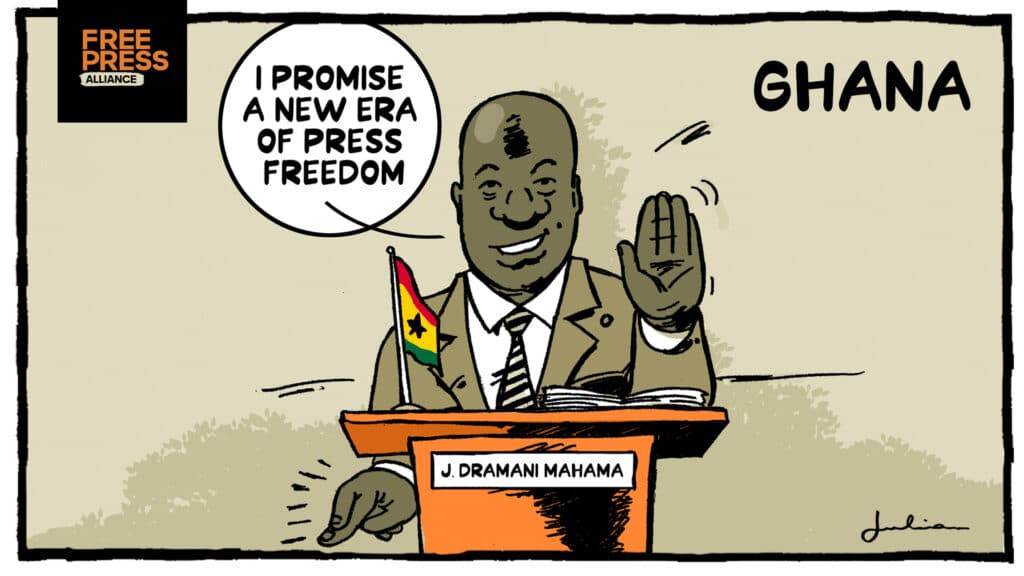
When John Dramani Mahama was sworn in as Ghana’s president in January 2025, he promised to usher in what he called an era of true media freedom. Eighteen months later, that promise looks increasingly hollow. According to a detailed investigation published by the Committee to Protect Journalists (CPJ) in June 2026, at least 17 journalists have been attacked in eight separate incidents during Mahama’s tenure, and in nearly every case, no one has been held accountable.
What the investigation found
CPJ’s reporting is not built on secondhand accounts. Journalists directly involved in each incident were interviewed to determine what, if any, justice they had actually received. The pattern that emerged is stark: state actors were responsible for roughly half the attacks. Police officers, firefighters, and soldiers were behind eight of the assaults, while illegal miners and unidentified individuals attacked the remaining nine.
Some of the documented cases include:
- February 11, 2025: Five journalists covering Council of State elections in Ghana’s Ashanti region were beaten by a group of unidentified men at the Ashanti Regional Coordinating Council, according to reporting by the International Federation of Journalists. Reporter Gideon Nana Peprah of GhanaWeb later described being struck with a metal object after the attackers accused him of filming them.
- February 21, 2025: Three journalists reporting on illegal gold mining were escorted by police into a forest in Ghana’s Western Region, where suspected illegal miners attacked them, damaging equipment and injuring one reporter’s arm, CPJ found. This was the sole case in which any form of restitution occurred: a court later ordered the miners to pay compensation for the damaged equipment.
- January 5, 2026: Reporter Samuel Addo was assaulted by firefighters while filming the aftermath of a market fire in Kasoa, near Accra. He told CPJ he lost roughly 10,000 cedis (about $901) during the five-minute assault and that, aside from an initial interview, no authority ever followed up with him.
- January 26, 2026: Two military officers in Walewale, in Ghana’s North-East region, flogged journalist Solomon Kwame Kanaluwe and factory reset his phone after he identified himself as a member of the press, according to CPJ’s account of the incident.
In every case, the journalists told CPJ they had clearly identified themselves, wearing press jackets, carrying identification, or stating their profession outright. It made no difference.
Words versus action
President Mahama has repeatedly condemned the attacks in public statements. During a January 2026 visit to the state-owned Ghana Broadcasting Corporation, he said security personnel needed “a reorientation” to understand that journalists, like security forces, are simply doing their jobs. He insisted that incidents “must be dealt with as firmly as possible.” When asked specifically about Addo’s case, Mahama said he believed the firefighters responsible had been identified and disciplined.
CPJ found no evidence to support that claim. Addo himself said he was never contacted again after his initial police interview. Of the eight documented incidents, the only one that produced any tangible accountability was the court-ordered compensation in the mining case, and even that addressed property damage, not the assault itself.
Ghana’s communications minister, Samuel Nartey George, reiterated the government’s stated commitment to press freedom in early June 2026, describing the press as central to the country’s democracy. The gap between that rhetoric and the lived experience of attacked journalists is precisely what CPJ’s investigation lays bare.
Part of a longer pattern
This is not a new phenomenon in Ghana, and that context matters. The 2019 murder of investigative journalist Ahmed Hussein-Suale Divela, shot near his home after his reporting exposed corruption in African football officiating, remains unsolved. CPJ marked the anniversary of his death in November 2025 by again calling for accountability, a call that has now gone unanswered for more than six years. CPJ had also written directly to Mahama in April 2025, urging him to secure justice for Hussein-Suale’s killing and reverse the broader pattern of impunity.
Civil society groups tracking press freedom in Ghana have documented a broader arc of abuse stretching back years: journalists detained and allegedly mistreated by national security operatives in 2019, reporters attacked by military personnel in 2020 despite promises of redress, and press members physically harassed and detained during the 2023 “Occupy Julorbi House” protests, as documented by the Africa Center for Democracy and Socio-Economic Development. Analysts there argue that each unpunished incident sends an unmistakable signal: that authority can suppress reporting without consequence.
Why this matters
Ghana has long been held up as a comparative bright spot for press freedom in West Africa. That reputation is now under visible strain. When journalists say, as one TV producer told CPJ, that nothing changed with the change in government, it reflects something more than individual grievances. It points to an accountability gap that outlasts any single administration, embedded in how security institutions treat the press during ordinary reporting, not just moments of political crisis.
The journalists CPJ interviewed were not asking for special treatment. They were asking for the same thing anti-impunity advocates have asked for since 2019: swift arrests, real investigations, and public accountability when the people meant to protect citizens, attack the reporters covering them. Until that happens, statements of support for media freedom, however sincerely meant, will keep running up against the same unanswered question that has followed Ghana’s press corps for years: who, if anyone, is ever actually held responsible?