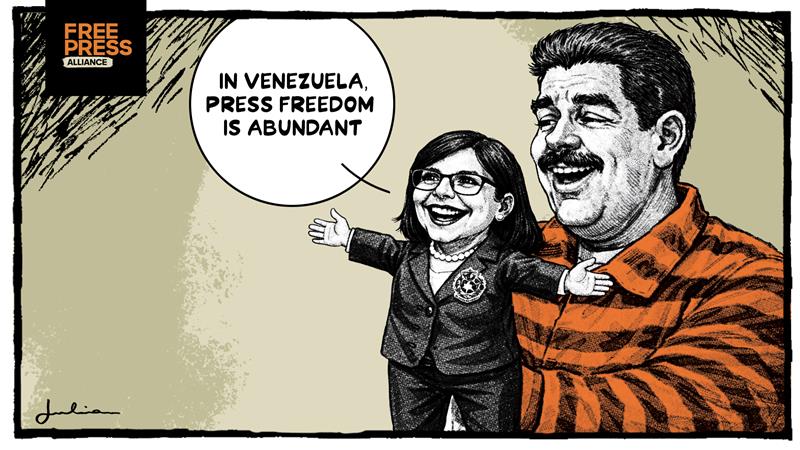
On January 3, 2026, a highly controversial U.S. military operation led to the capture of Venezuelan dictator Nicolás Maduro and his wife, Cilia Flores, triggering international uproar and deepening an already precarious crisis in Venezuela’s fragile media landscape. In the days that followed, the situation for journalists, both domestic and foreign, deteriorated markedly, revealing the entrenched and systemic repression that continues to stifle independent reporting.
A pre-existing crisis, now exacerbated
Even before these dramatic events, Venezuela’s press freedom had been in persistent decline. The domestic press had faced systematic harassment, censorship, and administrative restrictions for years, with numerous reported violations against journalists and media outlets. According to press freedom organizations, hundreds of incidents, including deportations, detentions, and digital censorship, had been recorded in the months leading up to late 2025, underscoring a broader pattern of repression under the Maduro regime.
The capture of Maduro, however, has intensified these pressures rather than alleviating them.
Detention and intimidation of journalists
In the immediate aftermath of Maduro’s removal, at least 14 journalists and media workers were detained while covering political developments in Caracas, particularly surrounding the inauguration of acting president Delcy Rodríguez and the installation of the new National Assembly. Most of those detained were correspondents from international media, illustrating that even global news organizations are not spared harassment.
The National Union of Press Workers (SNTP) documented that 13 of the detained journalists were released after intense scrutiny of their phones and equipment, while one was deported. During these detentions, authorities allegedly confiscated devices, accessed private data, and subjected reporters to intrusive interrogations.
Human rights defenders, press guilds, and unions have warned that such actions represent not just isolated incidents but part of a broader tactic to intimidate and silence critical voices. According to statements from the Society of Inter-American Press (SIP), impeding journalists at a time of deep political uncertainty only fuels misinformation, restricts access to reliable information, and undermines democratic norms.
Institutional and International Responses
The detentions and restrictions have drawn condemnation from several regional and global press freedom advocates. The International Federation of Journalists (FIP) has formally rejected the treatment of reporters and demanded full guarantees for journalists’ safety and independence.
Similarly, the SIP has issued urgent calls to Venezuelan authorities to ensure the free exercise of journalism, stressing that media access to plural and timely information is essential in the face of political upheaval.
These calls come amid broader appeals from press organizations urging the release of journalists still held arbitrarily and the removal of constraints that limit the public’s right to be informed.
Structural Barriers and Criminalization of Reporting
The treatment of journalists in the wake of Maduro’s capture reflects deeper structural obstacles that have long impeded free reporting in Venezuela. Laws and enforcement mechanisms that criminalize dissent and the labeling of journalistic activity as “terrorism” or “inciting hatred” have been frequently deployed against media workers, sometimes resulting in prolonged detentions without formal charges.
These tactics, including the surveillance and forced access to private devices, have contributed to a climate of fear among local journalists that extends beyond the immediate crisis. Many reporters self-censor and are reluctant to cover political events, fearing reprisals that could include arrests, visa issues, or professional blacklisting.
Digital Censorship and Information Control
In addition to physical intimidation, the Venezuelan state has employed digital censorship to limit access to independent information channels. Numerous online platforms and media outlets have been blocked or impeded by authorities, further narrowing the space for free expression and inhibiting public discourse.
This digital suppression exacerbates informational isolation at a time when citizens are desperate for clear, accurate reporting about their political future and daily realities.
The New Political Backdrop and Its Media Implications
The U.S. operation and Maduro’s capture have not resolved Venezuela’s political impasse. Delcy Rodríguez has been installed as acting president amid fierce opposition from key political factions and international ambiguity about legitimacy and governance structures. Meanwhile, the Trump administration has signaled intentions to exert significant influence over Venezuela’s political and economic affairs, setting conditions for a transition it deems acceptable to its interests.
In this shifting geopolitical context, Venezuelan authorities have tightened their grip on information, perceiving independent media as a threat to national stability or as proxies of foreign political agendas, further complicating the space for impartial journalism.
Conclusion: Between Repression and Resilience
The situation for journalism in Venezuela after the capture of Nicolás Maduro stands as a stark demonstration of how fragile press freedom can be in moments of political volatility. Journalists continue to face arbitrary detentions, invasive surveillance, digital repression, and criminalization of their work, all under the guise of maintaining order in a deeply fractured society.
Yet, amid these challenges, press organizations, both inside and outside Venezuela, continue to document abuses and demand accountability. Their advocacy underscores a crucial truth: free and independent journalism is not merely a professional concern, but a fundamental pillar of democratic resilience in times of upheaval.
As the crisis evolves, global media advocates must remain vigilant and steadfast in their support for Venezuelan journalists, whose ability to report freely remains under acute threat.