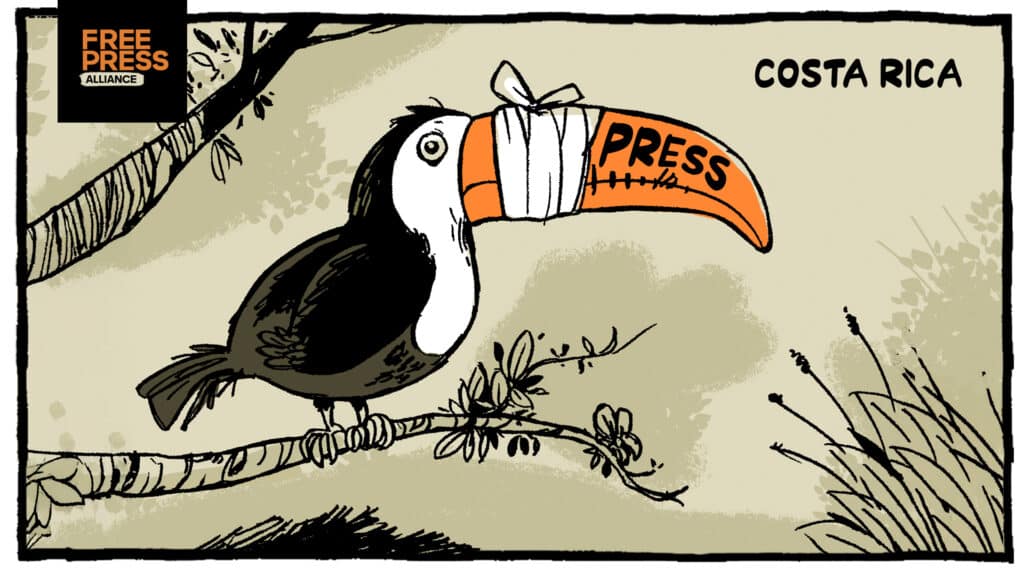
Costa Rica has long been recognized as a Central American outlier, a stable democracy with strong civil liberties, independent institutions, and a free press. Yet, as the 2026 national elections unfold, these longstanding assumptions are increasingly under strain. Political polarization, tensions between government and media, and a shifting media environment are reshaping the space for independent journalism, with serious implications for democratic accountability.
Recent electoral developments, including the election of populist candidate Laura Fernández, signal a potential turning point with consequences for press freedom and broader civic space.
The state of press freedom before the election
Under President Rodrigo Chaves, who took office in 2022, Costa Rica’s position in the global Reporters Without Borders Press Freedom Index declined sharply, from 8th in the world in 2022 to 36th in 2025. Reflecting a sustained downward trend over several years.
International press freedom organizations and observers have documented increasing hostility between the executive branch and independent media. Journalists have faced frequent verbal attacks, stigmatization, and public discrediting by government officials, dynamics that contribute to a climate of intimidation and self-censorship, according to a mission by the Inter American Press Association (IAPA).
At the same time, Costa Rica’s judiciary has occasionally acted as a counterbalance. The Constitutional Chamber has ruled in favor of journalists in cases involving restricted access to public events and other violations of press rights. While these rulings demonstrate that legal protections remain in place, they also highlight how fragile those protections can be in an increasingly polarized political environment.
Public trust in the media has also eroded, fueled by political polarization and competing narratives that challenge the credibility of independent journalism.
Press freedom during the 2026 elections
Political rhetoric and media coverage
Throughout the election campaign, public debate focused largely on security, crime, and economic governance. Press freedom rarely taking center stage.
Analysis of party platforms found that multiple major parties did not include specific proposals on freedom of expression or press freedom in their official documents, highlighting a relative absence of media-related commitments in core political agendas.
This omission reflects a broader trend in which immediate policy issues overshadow long-term democratic safeguards, even as tensions between political leaders and the press continue to grow.
Media regulation and communication rules
In the lead-up to the elections, the Tribunal Supremo de Elecciones (TSE) imposed strict limits on how public institutions can communicate through digital platforms during the campaign period. The goal was to prevent state resources from influencing electoral coverage and to ensure a fair contest.
Additionally, executive decisions, such as extending broadcast licenses, were designed to ensure continuity of information throughout the electoral cycle. While aimed at safeguarding media operations, these actions also revealed the political sensitivity surrounding media regulation during an already tense electoral period.
A civil society response
Civil society organizations and journalistic associations played a key role in defending press freedom during the election cycle. The Colegio de Periodistas publicly denounced censorship and supported judicial rulings that upheld journalists’ rights in the face of government pressure.
Meanwhile, academic institutions and civil society groups launched a National Agreement Against Disinformation and Hate Speech, in collaboration with organizations such as PROLEDI at the University of Costa Rica. The initiative aimed to promote ethical journalism and counter the spread of misinformation during the electoral process.
The 2026 election results and potential impacts
Final election results indicate that Laura Fernández, a populist candidate backed by outgoing President Chaves, won the presidency with nearly 50% of the vote, and her party made significant congressional gains.
Fernández’s campaign emphasized continuity with Chaves’s hardline approaches, particularly on security, and her rhetoric has raised concerns among critics who argue that an expanded governing majority could reshape institutional norms. Observers warn that, if unchecked, such trends might increase executive influence over public discourse and weaken institutional safeguards.
Broader trends: polarization and disinformation
Surveys and research show that a majority of Costa Ricans are concerned about the impact of disinformation on democracy. Journalists are now operating in a highly fragmented media environment where misinformation, online attacks, and distrust of traditional outlets complicate reporting on public affairs.
These pressures add to existing political challenges, placing journalists at the intersection of institutional hostility and digital disinformation campaigns.
Why this matters
Implications for democratic resilience
Costa Rica’s 2026 elections illustrate how even long-standing democratic systems are not immune to pressures that challenge press freedom. The campaign showed stark gaps in political attention to media rights, underscored risks of executive intimidation, and exposed structural vulnerabilities in civic discourse.
Policy and Advocacy Considerations
The Costa Rican case underscores the need for:
- Clear political commitments to protect media independence.
- Stronger legal and institutional safeguards.
- Active civil society engagement to counter disinformation.
- Guarantees of media access to information and protection from political interference.
Conclusion
Costa Rica’s reputation as a regional model for press freedom is being tested by electoral politics, growing polarization, and evolving media pressures. While legal protections remain intact, the country’s recent trajectory, including drops in international press freedom rankings, political rhetoric targeting journalists, and election-period regulatory shifts, demonstrates that protecting press freedom requires more than legal guarantees: it demands political will, public trust, and sustained vigilance.
The post-election period will be critical in determining whether Costa Rica can reaffirm its democratic foundations or drift toward norms that quietly undermine the free flow of information, with an outcome with implications far beyond its borders.