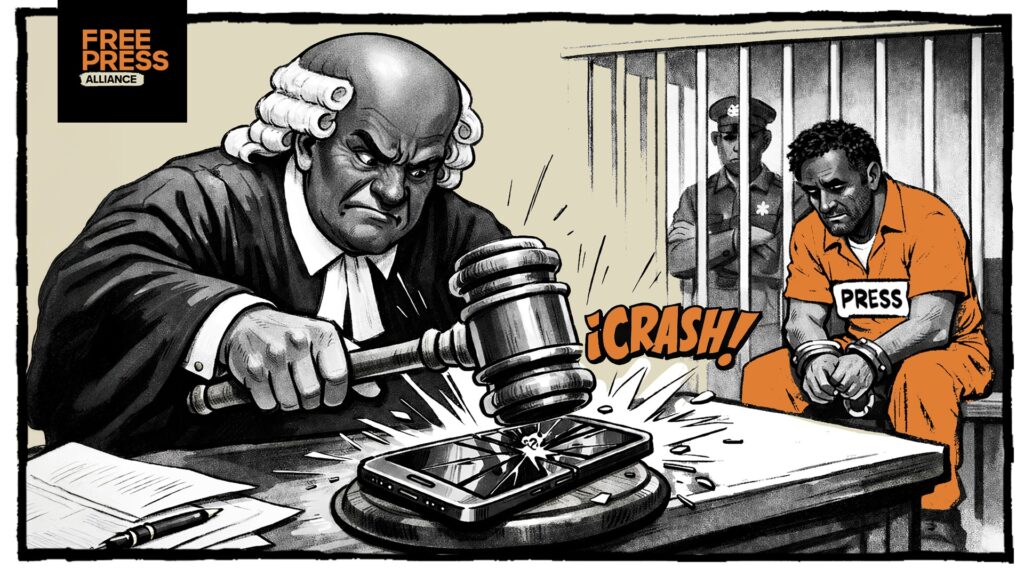
On February 27, the Court of Appeal of Kenya is set to rule on the constitutionality of the Computer Misuse and Cybercrimes Act. This law has increasingly become a flashpoint in the country’s press freedom landscape.
The ruling comes as journalist Peter Maseke Mwita faces up to 10 years in prison over a WhatsApp message he says was sent by mistake while seeking comment for a crime-related story. His case illustrates how cybercrime legislation, originally framed as a tool to combat digital harm, is now being used in ways that critics argue suppress legitimate journalism.
For Kenya’s media community, this ruling may determine whether digital reporting remains viable without fear of criminal prosecution.
From digital regulation to criminal prosecution
The 2018 Computer Misuse and Cybercrimes Act was introduced to address online fraud, cyber harassment, identity theft, and national security threats. However, several of its provisions have raised concern among press freedom advocates.
Section 27 criminalizes “cyber harassment” in broad terms, including communication that may “detrimentally affect” another person or is considered “grossly offensive.” The Act also penalizes the publication of “false information” that affects the reputation or rights of others, by heavy fines or imprisonment of up to 10 years.
These provisions lack clear definitions of key terms such as “false information,” “detrimentally affect,” or “grossly offensive.” Legal ambiguity of this scale creates discretionary enforcement power, a risk factor in environments where political sensitivity intersects with journalism.
The concern is not hypothetical. In 2017, Kenya’s High Court declared criminal defamation unconstitutional, recognizing that it disproportionately restricts freedom of expression. Critics argue that the cybercrimes law effectively reintroduces criminal defamation under a different label.
A pattern of arrests and intimidation
Mwita’s case is not isolated.
- Photojournalist Collins Kweyu was detained after requesting comment from a judge regarding corruption allegations.
- Blogger Albert Omondi Ojwang died in police custody after being arrested under false publication charges. A post-mortem contradicted police claims and suggested he was likely beaten.
- Software developer Rose Njeri was detained for building a tool that allowed citizens to email objections to proposed legislation.
- Student David Mokaya was charged for posting an AI-generated image of President William Ruto’s coffin before later being acquitted.
Not all cases resulted in convictions. Yet in press freedom contexts, the process itself can function as a punishment. Arrest, detention, bail conditions, legal costs, and prolonged court proceedings create chilling effects even when charges collapse.
Defense lawyers report that previously vocal clients have gone silent online after facing prosecution, a classic indicator of indirect censorship.
The chilling effect on crime reporting
Mwita, a security and court reporter, has stated that since his release on bail, he has avoided reporting on crime stories altogether due to fear of further persecution.
This form of self-censorship is among the most corrosive consequences of vague cybercrime laws. When journalists retreat from investigative reporting, particularly on organized crime, corruption, or state misconduct, public accountability suffers.
Freedom of expression does not erode overnight. It narrows incrementally, through intimidation, legal risk, and uncertainty.
The “Gen Z” protests and expanded digital control
The law’s tightening in October 2025 followed widespread protests against Kenya’s 2024 Finance Bill, during which young activists mobilized largely through social media platforms such as TikTok, Facebook, WhatsApp, and X.
Amendments granted a national cybercrime committee the power to ban websites or applications deemed to promote “unlawful activities.” While governments have a legitimate interest in addressing coordinated disinformation and digital incitement, unchecked executive authority to restrict online platforms risks undermining democratic participation.
The timing of these amendments, immediately following youth-led protests, has raised concerns that the law may be evolving into a mechanism of political control rather than public protection.
A regional trend
Kenya’s situation reflects a broader regional trajectory.
Across Africa, cybercrime and data protection laws are increasingly being used to pursue journalists under charges of false news, incitement, or digital harassment. In Zimbabwe, journalist Blessed Mhlanga was detained under the 2021 Cyber and Data Protection Act. Zambia recently enacted cyber laws, criticized by civil society for reintroducing criminal defamation through digital offenses.
This regional pattern reflects a global tension: governments expand digital regulation while democratic safeguards struggle to keep pace.
What is at stake
The constitutional brought by Blogger Association of Kenya (BAKE) represents more than a legal technicality. It is a constitutional test of proportionality and clarity in digital-era legislation.
If the Court of Appeal strikes down or narrows the contested provisions, it could reaffirm Kenya’s constitutional protections for free expression and restore confidence among journalists working online.
If it upholds the law in its current form, Kenya risks entrenching a framework in which:
- Vague language enables selective enforcement
- Criminal penalties replace civil remedies
- Journalists face prison time for reporting errors
- Self-censorship becomes normalized
For a country long considered one of East Africa’s more vibrant media environments, the implications are profound.
Conclusion
Free Press Alliance expresses deep concern over the continued use of Kenya’s cybercrime legislation to prosecute journalists, bloggers, and digital creators for speech-related offenses.
Laws that criminalize undefined “false information” or vaguely framed digital conduct are incompatible with international standards on freedom of expression. Regulation of harmful online activity must be precise, proportionate, and necessary, not punitive tools to shield those in power from scrutiny.
As Kenya’s judiciary prepares to rule, this moment represents an opportunity to reaffirm that democracy requires not only digital regulation but constitutional restraint.
The outcome will signal whether Kenya’s digital future strengthens accountability or narrows the space for independent journalism.