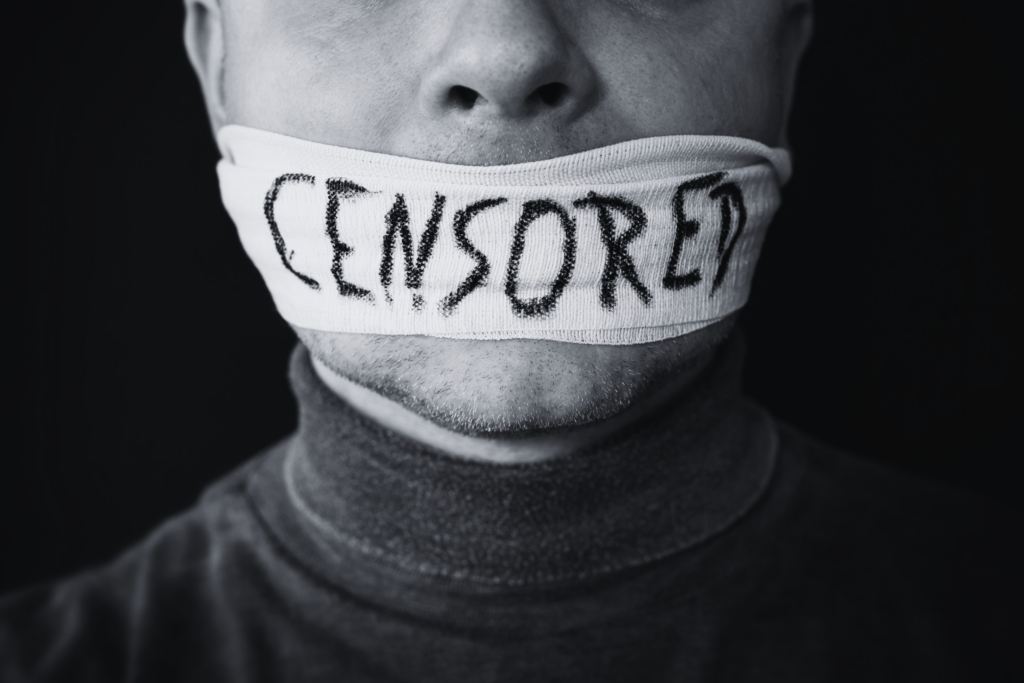
The most efficient censorship is the kind no authority has to enforce. When journalists, writers, and readers decide for themselves what is too risky to say, repression works without leaving a trace.
Most press freedom reporting counts what can be counted: journalists killed, reporters jailed, outlets shut down. Self-censorship is different. As Nik Williams of Index on Censorship wrote for openDemocracy, it leaves no fingerprint. A writer who quietly drops a topic produces no record of the decision, and the story simply never exists.
That invisibility is what makes it so useful to those in power, and so hard to defend against. This article looks at how fear is produced, what the evidence says about its scale, and why it matters well beyond the newsroom.
Fear is manufactured, then it runs on its own
Repression rarely needs to reach everyone. Violence, prosecution and impunity work as signals to everyone else. UNESCO’s latest biennial report on journalist safety, published on 2 November 2026, counted 189 journalists killed in 2024 and 2025, a 20 percent increase on the previous two years. It also found that 86 percent of journalist killings remain judicially unresolved, the first rise in impunity since UNESCO began tracking it in 2012. When the likeliest consequence of a killing is no consequence at all, every reporter nearby can do the math.
The legal route is quieter and increasingly common. In its 2026 World Press Freedom Index, Reporters Without Borders (RSF) found that its legal indicator deteriorated in 110 of 180 countries, the steepest fall of its five indicators. RSF points to the misuse of national security and anti-terrorism laws, “false information” statutes and abusive lawsuits (SLAPPs), and stresses that this is not confined to authoritarian states: it cites Japan’s state secrets legislation and SLAPPs in France among its examples.
Hong Kong: when the effect arrives before the enforcement
Hong Kong shows how self-censorship can precede the law that is supposed to cause it. In June 2020, before the national security law took effect, a Hong Kong Journalists Association survey found that 81 percent of respondents expected self-censorship to become “more severe” if it passed. A year later, a Foreign Correspondents’ Club survey reported that 56 percent of journalists had self-censored since the law was imposed.
The silence can even distort the measurement. When the association’s own press freedom survey drew responses from only about a quarter of its members, its chair suggested the low turnout could itself reflect the climate. Hong Kong now sits 140th in the RSF Index, and RSF notes that publisher Jimmy Lai received a 20-year sentence, the heaviest ever imposed on a journalist in the territory.
Not only an authoritarian problem
The chilling effect does not stop at democratic borders. In 2013, PEN America surveyed more than 520 American writers about government surveillance. 85 percent said they were worried, and 16 percent had avoided writing or speaking about a topic, with another 11 percent having seriously considered it. PEN’s 2015 follow-up, Global Chilling, covered 772 writers in 50 countries and found self-censorship reported by 34 percent of writers in liberal democracies, against 44 percent in semi-democratic and 61 percent in authoritarian countries. The gap was real, but smaller than many would expect.
behavioral data points the same way. A study by Jon Penney in the Berkeley Technology Law Journal found that traffic to Wikipedia articles on terrorism-related topics fell by nearly 30 percent after the 2013 surveillance revelations. A separate Facebook experiment by Elizabeth Stoycheff, summarized by the EFF, found that awareness of government monitoring made people less willing to voice minority views, reinforcing the majority opinion.
Online abuse and the quiet retreat
Harassment achieves a similar result through a different route. The UNESCO-commissioned study The Chilling, led by the International Center for Journalists (ICFJ), surveyed women journalists and found that 73 percent had experienced online violence. Among those targeted, 30 percent said they responded by self-censoring on social media, and 20 percent withdrew from online interaction entirely. A later ICFJ study for UN Women, reported in 2025, put the share experiencing online violence at 75 percent. UNESCO’s 2026 safety report adds that the proportion of women reporting offline violence linked to online attacks rose from 20 percent in 2020 to over 40 percent in 2025.
Measuring the unmeasurable
UNESCO’s World Trends in Freedom of Expression and Media Development report, published in December 2025, tries to quantify the trend. It records a 10 percent decline in global freedom of expression between 2012 and 2024 and, over the same period, a 63 percent rise in self-censorship among journalists, roughly 5 percent a year. That figure is a relative increase on UNESCO’s own measure, not the share of journalists who self-censor, and it should not be quoted as such.
There is also an interpretive trap. Coverage of Malaysia’s 2026 ranking reports RSF cautioning that a country can look better when self-censorship reduces physical attacks, because journalists are avoiding controversial topics altogether. Fewer incidents is not always more freedom. Sometimes it is the sign that the pressure has worked.
What the public loses
The cost falls on readers who never learn what they are missing. PEN America’s researchers noted that part of what makes self-censorship so troubling is the impossibility of knowing precisely what society loses because of it. A gap in coverage looks like a normal news cycle. Corruption stays unexamined, abuses go undocumented, and the public debates with less information than it needs, without realizing it.
What can help
The remedies are not mysterious, but they are demanding. RSF’s 2026 analysis calls for ending the criminalization of journalism, including the misuse of national security laws and SLAPPs, and reports that in more than 80 percent of the countries it assesses, protection mechanisms are seen as non-existent or ineffective. UNESCO is calling on states to make accountability mechanisms keep pace with new threats, particularly in conflict. Newsrooms have a role too: ICFJ found that only about a quarter of women journalists reported online attacks to their employers, and its recommendations to news organizations and platforms address that gap.
Naming self-censorship is the first step, because a problem that leaves no record cannot be fixed until someone chooses to look for it.
A note on the evidence
Several figures above come from self-reported surveys of specific groups (writers, women journalists, members of professional associations in Hong Kong) rather than representative samples, and the response rates can themselves be affected by the climate being measured. They show strong, consistent patterns across contexts, but they should be read as indicators rather than precise global measurements.
Sources
- UNESCO, World Trends in Freedom of Expression and Media Development 2022–2025
- UN Regional Information Centre, summary of UNESCO’s 2026 Director-General’s report on journalist safety
- Capital FM, “Six in seven journalist killings remain unresolved, UNESCO warns” (2 Nov 2026)
- RSF, 2026 World Press Freedom Index: press freedom at a 25-year low
- Business Today Malaysia, Malaysia’s 2026 RSF ranking (30 Apr 2026)
- CPJ, Journalists in Hong Kong fear for personal safety (June 2020)
- Japan Times / Bloomberg, Hong Kong FCC survey (Nov 2021)
- ThePrint / VOA-ANI, Hong Kong Journalists Association survey
- PEN America, Global Chilling (2015)
- PEN America, Chilling Effects (2013)
- Publishing Perspectives on the 2013 PEN survey
- Authorlink on PEN’s 2015 survey
- Penney, “Chilling Effects: Online Surveillance and Wikipedia Use,” Berkeley Technology Law Journal 31(1) (2016)
- Citizen Lab summary of the Penney study
- EFF, “When Surveillance Chills Speech” (Penney and Stoycheff studies)
- openDemocracy / Index on Censorship, “Writers silenced by surveillance”
- ICFJ, The Chilling: A global study of online violence against women journalists
- ICFJ, recommendations for news organizations and platforms (2022)
- Tribune India on UNESCO’s World Trends report and the 2025 ICFJ/UN Women findings
- Eastleigh Voice on the 63 percent self-censorship finding