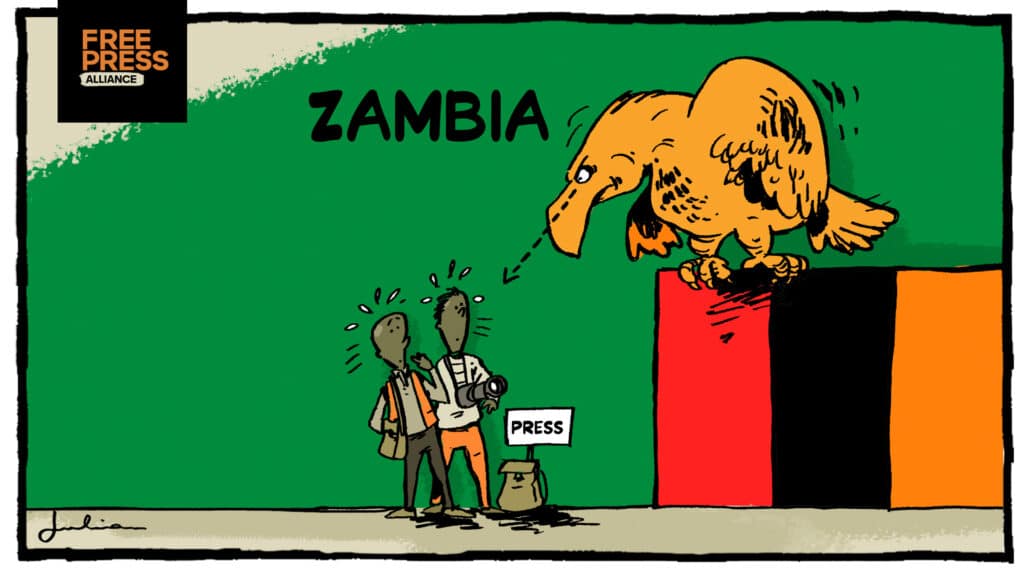
As Zambia approaches its August 2026 general election, a growing coalition of lawyers, press freedom advocates, and civil society organizations is pushing back against what many see as an escalating crackdown on independent journalism and freedom of expression.
At the center of the legal battle are two controversial laws enacted in 2025, the Cyber Security Act and the Cyber Crimes Act, which critics argue grant sweeping surveillance powers to the state while criminalizing forms of journalism and online speech. According to the Committee to Protect Journalists, Zambian lawyers are now challenging these laws in court, warning that they could fundamentally undermine press freedom ahead of a highly contested election.
The case represents one of the most significant legal confrontations over media freedom in Zambia in recent years. Lawyers involved in the challenge argue that the legislation threatens constitutional protections surrounding privacy, due process, and freedom of expression by allowing broad powers of interception, surveillance, and access to digital communications with limited judicial oversight.
A legal fight over the future of journalism
Among the leading figures challenging the cyber laws is lawyer Josiah Kalala, head of the Chapter One Foundation, who has joined the petition originally filed by the Law Association of Zambia. The petition seeks to overturn key sections of the legislation on constitutional grounds.
The case has also attracted support from international organizations. According to CPJ, the Committee to Protect Journalists and the International Justice Clinic at the University of California, Irvine School of Law provided legal support to the Free Press Initiative, which joined the case as amicus curiae alongside Amnesty International.
Critics say the legislation introduces vague offenses that could easily be weaponized against journalists and critics of the government. The Cyber Crimes Act reportedly allows prison sentences for disseminating information deemed false or damaging to another person’s reputation. It also criminalizes possession or transmission of broadly defined “critical information,” which can include matters linked to public safety, economic stability, or national security.
Press freedom groups warn that these provisions could create a chilling effect inside newsrooms, particularly during an election cycle when investigative reporting and scrutiny of political actors are essential to democratic accountability.
Harassment of journalists intensifies before elections
The legal challenge comes amid increasing reports of intimidation, assaults, and harassment targeting journalists in Zambia. CPJ documented multiple incidents involving reporters covering political events and opposition activities.
One of the most alarming incidents occurred in April 2026, when suspected supporters of the ruling United Party for National Development (UPND), reportedly accompanied by police officers, forced their way into Radio Mpongwe and stopped the broadcast of a political program discussing alleged corruption within party structures. According to the station manager, authorities claimed the program was attacking government leadership.
Days later, journalist Alfonso Kasongo of privately owned Power FM was allegedly assaulted and tasered while covering a campaign event. CPJ reported that Kasongo was filming supporters restraining an individual accused of throwing stones at party officials when he was attacked despite identifying himself as a journalist.
The ruling party later stated that it does not condone violence against journalists and called for investigations into the incidents. However, media advocates argue that the attacks reflect a broader deterioration of the press freedom climate in Zambia.
According to a survey by the Media Institute of Southern Africa (MISA), 62% of journalists in Zambia believe the press does not operate freely, while 41% reported experiencing harassment during the second half of 2025.
The return of self-censorship
Journalists and editors say the combination of legal threats, political intimidation, and surveillance fears is encouraging self-censorship inside newsrooms.
Jeremy Munthali, editor-in-chief of The Mast, described the media environment as “strained and increasingly uncertain,” noting that intimidation directed at journalists critical of those in power has created “a climate of caution.”
The impact is particularly severe for investigative journalists. Reporter Thomas Zgambo of Zambian Whistleblower is currently facing sedition charges linked to his reporting on corruption and governance issues. If convicted, he could face years in prison.
Sedition laws in Zambia date back to the colonial-era Penal Code and have historically been used by successive governments to suppress dissent. Press freedom advocates argue that the revival of these charges, combined with the new cyber laws, signals a dangerous expansion of state control over public discourse.
The fear of prosecution is already affecting editorial decisions. Journalists interviewed by CPJ said some stories of public interest are no longer being published because of concerns over arrests, surveillance, or criminal charges.
A broader democratic concern
The media crackdown is unfolding alongside wider concerns about democratic backsliding in Zambia ahead of the elections. Human rights organizations and civil society groups have increasingly criticized measures that they say concentrate power and restrict civic space.
In May 2026, Zambia also faced international criticism after abruptly canceling RightsCon, one of the world’s largest summits on technology and human rights, only days before it was due to begin in Lusaka. Civil society leaders described the move as part of a growing pattern of censorship and shrinking democratic freedoms.
At the same time, legal and constitutional reforms pushed by President Hakainde Hichilema’s administration have sparked concern among opposition groups and rights advocates, who fear that state institutions are becoming increasingly politicized ahead of the vote.
For many Zambian lawyers and journalists, the court challenge against the cyber laws is therefore about more than digital regulation. It is about whether independent journalism can survive in an increasingly hostile political environment.
The outcome of the case could shape not only the future of media freedom in Zambia, but also the credibility of the country’s democratic institutions during one of the most consequential elections in its recent history.