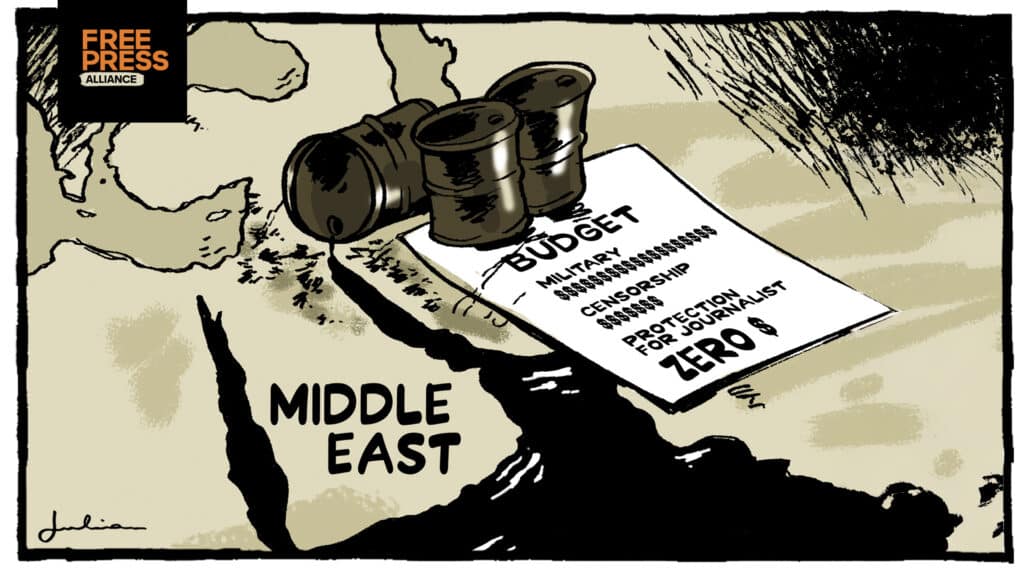
Since the outbreak of the Iran war on February 28, marked by U.S. and Israeli strikes on Iran followed by Tehran’s retaliation across the region, press freedom conditions have rapidly deteriorated. What has emerged is not only a military escalation, but a parallel assault on the ability of journalists to report freely and safely.
Across multiple countries, journalists have been killed, detained, harassed, and obstructed, while governments have imposed sweeping censorship measures. The conflict has exposed a deeply concerning pattern: in times of war, control over information becomes a strategic objective, often at the expense of truth and accountability.
A regional pattern of suppression
The impact on media freedom has not been confined to one country. Instead, it has spread across a wide regional landscape, including Iran, Israel and the occupied Palestinian territory, Lebanon, Iraq, Jordan, and the Gulf states.
Authorities have implemented a range of restrictive measures: from internet shutdowns and broadcast limitations to legal threats and direct interference with reporting. In Iran, a near-total internet blackout severely limited journalists’ ability to communicate and document events. In Israel, new military censorship directives imposed strict controls on how the media could cover missile strikes and security operations.
Elsewhere, governments have restricted journalists’ access to information and threatened them with legal consequences for publishing unauthorized content. These actions reflect a broader trend of information control, where narratives are tightly managed, and independent reporting is increasingly constrained.
Targeting Journalists and Media Infrastructure
Beyond legal and administrative restrictions, journalists have faced direct physical risks. Media outlets have been damaged in airstrikes, and reporters have been assaulted, detained, or prevented from covering events on the ground.
In Lebanon and Iraq, journalists described being attacked or obstructed while reporting, while in Israel, security forces detained reporters and confiscated equipment during live coverage. In several cases, journalists were explicitly ordered to stop filming or leave reporting locations, despite complying with official guidelines.
The targeting of media infrastructure further compounds these risks. Strikes on broadcasting facilities and newsrooms not only endanger journalists but also disrupt the flow of information to the public. Whether intentional or not, these attacks have a chilling effect on coverage and reduce the visibility of events unfolding in conflict zones.
Escalating censorship and legal pressure
Censorship has emerged as a central feature of the conflict. Governments across the region have introduced measures that restrict both journalists and the public from documenting or sharing information.
In Iran, authorities have gone as far as criminalizing reporting on military strikes, framing it as collaboration with hostile actors. In Gulf countries, individuals have been warned against photographing or sharing images of attack sites, with potential penalties including imprisonment.
Such measures not only limit independent journalism but also foster an environment of fear and self-censorship. When legal risks are combined with physical threats, the space for free and critical reporting shrinks dramatically.
The Human Cost: Journalists killed and threatened
The war has already claimed the lives of journalists. Media workers in Iran, Gaza, and Lebanon have been killed in strikes, underscoring the extreme dangers faced by those covering armed conflict.
In addition to fatalities, journalists have reported increasing threats, both online and offline. These include harassment, intimidation, and targeted campaigns aimed at silencing critical voices. The cumulative effect is a media environment in which journalists must weigh personal safety against their duty to inform.
Information as a battlefield
The developments since February 28 highlight a broader reality: in modern conflicts, information itself becomes a battleground. Controlling narratives, limiting coverage, and silencing journalists are tactics used alongside military operations.
This dynamic has profound implications. Without independent reporting, misinformation can flourish, accountability is weakened, and the public is left without reliable insight into events that shape regional and global stability.
Conclusion
The Iran war has triggered not only a humanitarian and geopolitical crisis but also a severe press freedom emergency. The pattern of violations documented across the region points to a systematic erosion of the rights of journalists.
Free Press Alliance strongly condemns the widespread and coordinated attacks on press freedom since the start of the conflict. The killing of journalists, destruction of media infrastructure, arbitrary detentions, and expansive censorship measures constitute a direct assault on the public’s right to information. All parties involved must immediately uphold international standards, protect journalists on the ground, and ensure that reporting can continue without fear, interference, or retaliation.