
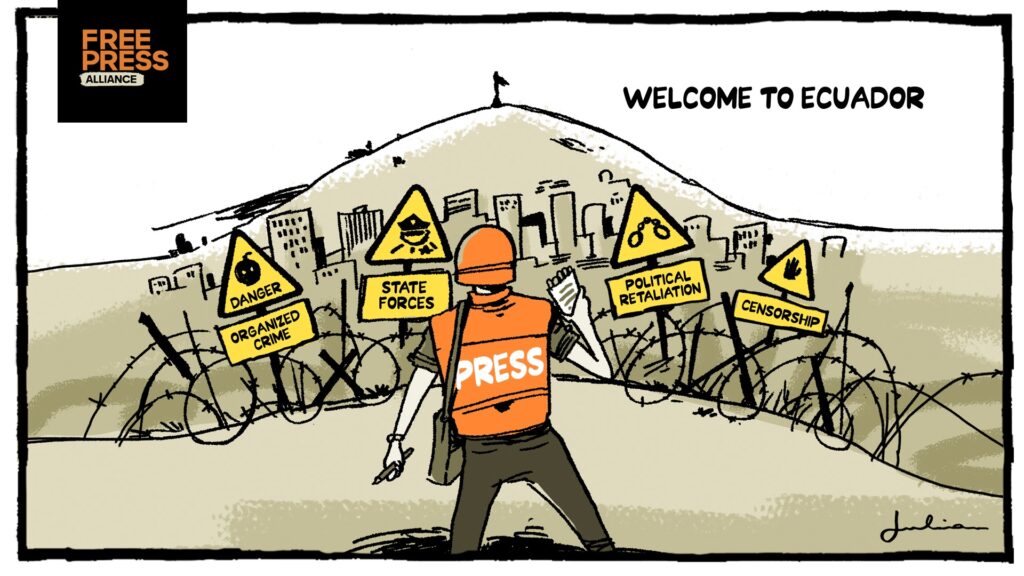
Ecuador is experiencing a deepening crisis that now strikes at the heart of its civic life. The twin pressures of organized crime-linked violence tied to narcotrafficking and institutional actions that curb press access and coverage are eroding press freedom across the country. Journalists and media outlets are confronting threats ranging from physical violence and death threats to legal harassment and censorship.
This analysis examines how these forces are converging to restrict independent reporting, stifle accountability, and weaken democratic norms in Ecuador.
Narcotrafficking violence as a catalyst for press suppression
Since 2022, Ecuador has witnessed a dramatic surge in criminal violence driven by narcotrafficking networks competing for control of transit routes and illicit economies. This has contributed to one of the highest homicide rates seen in the country’s recent history. Such instability has had spillover effects on journalists covering corruption, security, and local governance. Threats from armed non-state actors and criminal gangs have made coverage of public safety and illicit economies increasingly dangerous.
Rising threat levels: attacks, death threats, and violence
2025: A brutal year for journalists
Press freedom monitors reported record numbers of aggressions against journalists in Ecuador during 2025:
- Fundación Periodistas Sin Cadenas (FPSC) documented 298 aggressions against journalists and media workers during the year, nearly a 30 % increase compared with 2024 figures, including physical attacks, censorship, detentions, and violence from both state and non-state actors.
- These attacks ranged from physical assaults and detentions to intimidation and censorship by security forces and other actors.
This rising tide of violence has amounted to a climate of fear, in which journalists face threats not only from criminal groups but also during social unrest and state responses that lack adequate protection for media workers.
2026: Early evidence of continued risks and death threats
The crisis has persisted into the new year. In January 2026 alone, Periodistas Sin Cadenas recorded 32 aggressions against journalists, roughly one per day, including three explicit death threats against press workers in provinces such as Pichincha and Santa Elena.
These figures underline that threats to press freedom are enduring, compounding the already hazardous context for reporting in Ecuador.
Institutional censorship: armed forces and access restrictions
In a troubling development for freedom of expression in Ecuador, the Armed Forces have recently sought to condition and restrict journalistic access to official information and events based on subjective criteria, actions widely criticized as censorship.
In late January 2026, the Joint Command of the Armed Forces issued internal directives that seek to evaluate, rank, and restrict media accreditation for coverage of military events and official activities. These criteria include:
- The media outlet’s editorial line.
- Its historical informational treatment of the Armed Forces.
- Professional conduct.
- Whether reporting is deemed “harmful” to the Army’s image.
Under this framework, outlets that fail to meet these arbitrary standards could be denied coverage access. The system proposes internal ranking matrices classifying outlets as apt, conditionally apt, or not apt for accreditation based on qualitative judgments.
Civil society and press groups condemn the disposition
Press freedom defenders have strongly condemned these measures as censorship and a violation of constitutional and international human rights protections:
- Fundación Periodistas Sin Cadenas described the procedures as censura previa (pre-publication censorship) and a direct threat to press freedom.
- Fundamedios and other press associations have condemned the restrictions as incompatible with democratic norms, emphasizing that military institutions have no authority to evaluate editorial lines or decide who can report on official matters.
- More than 50 journalists, outlets, and NGOs, including international press freedom organizations, have signed statements demanding that the accreditation evaluation system be immediately revoked, asserting that it constitutes an illegitimate restriction on freedom of expression.
These institutional pressures add a new and insidious dimension to press freedom violations in Ecuador; not only are journalists threatened by violence and crime, but they are also being systematically excluded from the information they need to do their jobs.
Self-censorship, exile, and democratic impact
Chilling effects and loss of coverage
The combined pressures of violence and institutional restrictions have deepened self-censorship among journalists. Many reporters increasingly avoid covering topics that might provoke retaliation from criminal groups or denial of accreditation by military authorities, particularly stories about corruption, organized crime, or abuses by public officials.
This fear of reprisal narrows public discourse and deprives communities of vital information.
Some journalists have also been forced into internal displacement or exile, further shrinking the space for independent reporting.
Why this matters: press freedom and democratic health
A free press is a cornerstone of democratic societies: it informs citizens, enables accountability, and provides transparency into the exercise of power. When journalists face violence, threats, and censorship, the public loses access to the information necessary for civic participation and oversight. In Ecuador today, that loss is becoming reality.
The combination of organized crime violence and institutional censorship illustrates a complex and dangerous environment where:
- Journalists face physical violence and death threats from criminal groups.
- Press access to official information can be curbed arbitrarily.
- Editorial freedom is undermined through exclusionary accreditation practices.
Together, these trends weaken the core functions of the press and threaten democratic governance in Ecuador.
Conclusions and urgent recommendations
The erosion of press freedom in Ecuador requires concerted attention and action:
- Immediate repeal or suspension of restrictive accreditation guidelines imposed by the Armed Forces.
- Full, transparent investigations into threats, aggressions, and deaths of journalists, with accountability for perpetrators.
- Strengthened legal protections and operational safeguards for press workers, especially in contexts of violence and security operations.
- Support for independent media outlets, safety training, and legal aid to enable journalists to continue reporting without fear of reprisal.
Safeguarding press freedom in Ecuador is not only essential for the safety of individual journalists but also critical for the health and future of the country’s democracy itself.