Since taking office in December 2023, Argentine President Javier Milei has overseen a sharp deterioration in relations between the government and the press. What began as hostile rhetoric toward critical media has evolved into a broader climate of stigmatization, legal harassment, and repression, raising serious concerns among journalists, press freedom organizations, and international human rights bodies.
A surge in attacks and stigmatizing rhetoric
According to FOPEA (Foro de Periodismo Argentino), 2025 marked the most damaging year for press freedom in Argentina since the organization began monitoring attacks against journalists. Between January and December 2025, FOPEA recorded 278 attacks, representing a 55% increase compared to 2024 and a 139% rise compared to 2023. FOPEA further reported that President Milei was linked to 43% of these attacks, primarily through stigmatizing discourse, insults, and public defamation
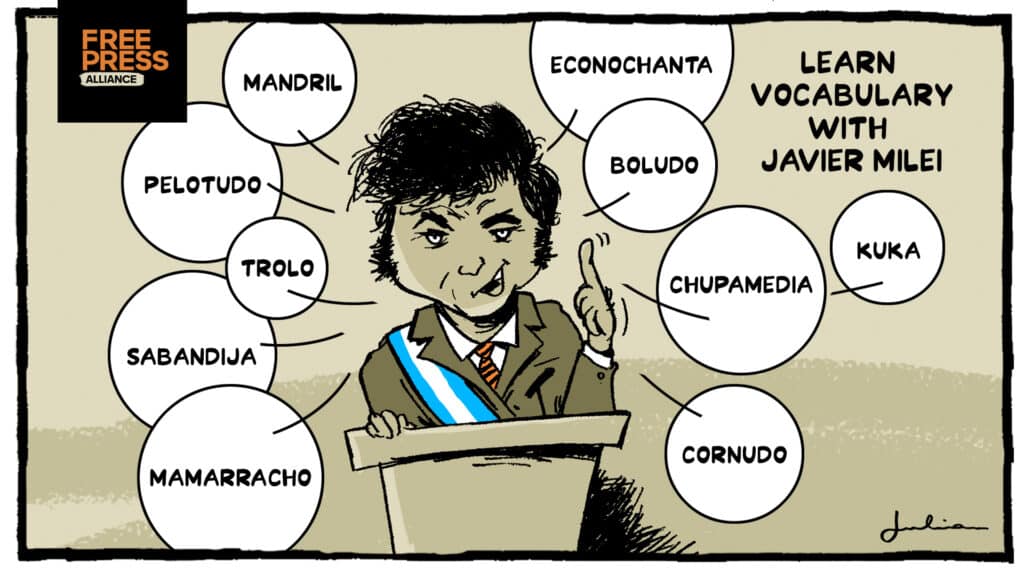
A FOPEA study analyzing 113,649 posts from Milei’s X account between December 2023 and September 2025 found that the president routinely referred to journalists as “criminals,” “corrupt,” “apes,” and “terrorists,” while framing them as members of a political elite (“casta”) or as supporters of Kirchnerism (“kukas”)
Reporters Without Borders (RSF) has also documented Milei’s repeated verbal attacks on journalists, including calling them “trash,” “baboons,” “politicians’ and whores,” and declaring that “people don’t hate journalists enough.” RSF ranked Argentina 87th out of 180 countries in its 2025 World Press Freedom Index, citing the president’s hostility toward the media as a central factor.
Insults as a political strategy
Milei’s attacks are not isolated outbursts but part of a sustained communication strategy. FOPEA found that around 70% of the president’s posts targeting journalists contain derogatory or stigmatizing language. Due to the institutional weight of the presidency, each post triggers coordinated waves of online harassment, amplifying insults and threats against targeted journalists.
Press freedom groups warn that this environment fosters self-censorship, as journalists increasingly weigh the personal, legal, and psychological costs of critical reporting. PEN International has described this dynamic as a serious deterioration of freedom of expression under Milei’s government
Legal harassment and judicial pressure
Alongside verbal attacks, legal harassment of journalists has intensified. FOPEA recorded 30 cases of legal intimidation in 2025, nearly triple the number documented in 2024.
One high-profile case involves journalist Julia Mengolini, who has faced legal actions linked to President Milei and members of his administration. The harassment escalated when deepfake videos portraying her in fabricated sexual acts circulated online. Mengolini has since filed a lawsuit against the president, noting in an interview with CPJ that “it’s very difficult for a judge to investigate a president”.
Veteran journalist Alejandro Alfie, who covers media and freedom of expression for Clarín, has received extrajudicial letters and mediation summons in at least four ongoing cases since 2024, including lawsuits from a Milei-aligned influencer and a consultant to the president who owns part of the outlet La Derecha Diario. Alfie has reported serious health consequences linked to stress, including asthma and metabolic issues.
The International Federation of Journalists (IFJ) has also raised alarms after Milei filed or promoted legal complaints against multiple journalists within a single week, warning that such actions constitute judicial intimidation.
Gender-based violence against women journalists
FOPEA reports that 22% of attacks against the press in 2025 targeted women journalists, highlighting the gendered dimension of repression.
Additional studies published by Argentinian Journalists and Chequeado show that online harassment, sexualized abuse, and coordinated attacks against women journalists are systemic, with many originating from verified accounts linked to political figures or public officials. These attacks seek not only to discredit professional work but also to intimidate women into silence.
Physical attacks and police repression
Hostility toward the press has also manifested in physical violence. In March 2025, photojournalist Pablo Grillo was seriously injured after being hit on the head by a tear-gas canister fired by police while covering a protest in Buenos Aires. Press unions and human rights organizations described the incident as emblematic of the growing risks journalists face while reporting on social unrest.
Institutional pressure on the media ecosystem
Beyond direct attacks, Milei has announced plans to close or privatize state-owned media and cut funding for community outlets, raising concerns about media pluralism and access to information. PEN International and regional human rights groups warn that restrictions on access to public information and the weakening of public media further undermine democratic accountability.
Conclusion
Taken together, these developments point to a systemic and escalating assault on press freedom in Argentina, characterized by public stigmatization, legal harassment, gender-based violence, physical attacks, and institutional pressure on the media ecosystem. The sustained nature of these actions, particularly when driven or amplified by the country’s highest political authority, poses a serious threat to democratic debate and the public’s right to information.
At Free Press Alliance, we affirm that freedom of expression and independent journalism are not privileges granted by governments, but fundamental rights protected under international human rights law, including the American Convention on Human Rights. Political leaders have a responsibility not only to tolerate scrutiny but to actively safeguard the conditions that allow journalists to work freely and without fear of retaliation.
As Argentina navigates profound political and economic challenges, the role of a free and pluralistic press is more critical than ever. The international community, regional human rights mechanisms, and civil society must continue to monitor these violations closely and demand accountability. Defending press freedom is essential to defending democracy itself.